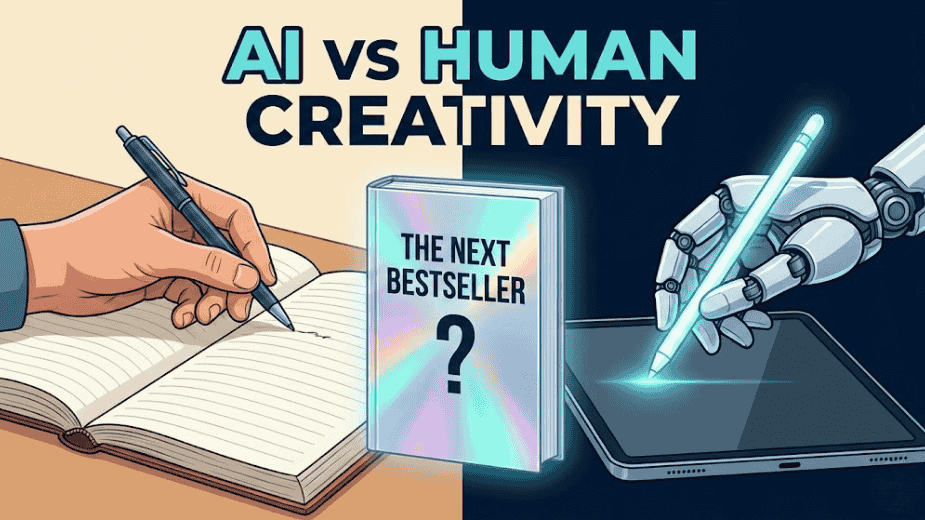
The question of whether artificial intelligence can truly replace human creativity in writing has moved from science fiction to boardroom debates. As AI writing tools proliferate and capabilities expand, we’re witnessing a fundamental transformation in how content is created, consumed, and valued. But can algorithms genuinely match the creative genius that produces bestselling novels?
The Rise of AI in Writing: By the Numbers
The adoption of AI writing tools has skyrocketed in recent years, fundamentally changing the creative landscape:
Market Growth and Adoption
- 90% of content marketers now use AI writing tools in 2025, up dramatically from 83.2% in 2024 and just 64.7% in 2023.
- The AI writing tool market is projected to reach $1,402.3 million by 2030, signaling massive industry transformation.
- ChatGPT dominates with 800 million weekly active users as of mid-2025, commanding an estimated 62.5% of the AI assistant market.
- By 2025, 90% of books published globally could be influenced by AI technologies in some capacity.
How Authors and Marketers Use AI
Among the 23% of authors who use AI in their work:
- 47% use it as a grammar tool
- 29% use it to brainstorm plot ideas and characters
- Less than 10% use AI to generate actual text
Content marketers primarily leverage AI for:
- 71.7% for outlining
- 68% for content ideation
- 57.4% for drafting content
The Productivity Promise: Speed vs. Quality
The efficiency gains from AI writing are undeniable:
- Bloggers using AI spend 30% less time writing blog posts.
- AI speeds up content creation by 430% on average, according to Nielsen Norman Group research.
- Organizations using AI report 61% higher productivity in content creation.
- 41% of users have seen significant improvement in their content creation productivity with AI writing tools.
However, this efficiency comes with caveats. While 44% of respondents believe AI writing tools produce good quality content, 71% of publishers say AI drafts still need major editing before publication.
The Creativity Question: Can Machines Be Truly Creative?
This is where the debate intensifies. Recent scientific research reveals a nuanced picture:
AI Outperforms Average Humans, But Not Top Creatives
A landmark 2023 study published in Scientific Reports found that:
- AI chatbots outperformed average human participants in divergent thinking tasks (the alternate uses task)
- However, the best human ideas still matched or exceeded those of the chatbots
- AI produced consistently good outputs, while human responses ranged from poor to exceptional
AI Enhances Individual Creativity But Reduces Collective Diversity
A 2024 study in Science Advances revealed a critical paradox:
- AI causally increased the average novelty and usefulness of individual stories
- Less creative writers benefited most from AI assistance
- However, AI-generated stories were more similar to each other than human-only creations, reducing collective diversity
- This creates a potential “social dilemma” where individual gains lead to collective homogenization
The Linguistic Novelty Gap
Using a specialized program called DJ Search, researchers found that:
- Humans outscored AI by approximately 80% in poetry
- 100% higher in novels
- 150% higher in speeches
The study concluded that while AI can remix words effectively, its output remains fundamentally derivative rather than truly novel.
AI-Generated Books: The Reality Check
Despite the hype, fully AI-written bestsellers remain elusive. Here’s what we know:
Notable AI-Written Books
- “Aum Golly” series (Finland, 2021) – Poetry collection using GPT-3, completed in 24 hours
- “The Day A Computer Writes A Novel” (Japan, 2016) – Passed the first round of a literary contest
- “1 the Road” (Ross Goodwin, 2017) – Created during a road trip using sensors and AI
However, none of these have achieved mainstream bestseller status. The closest success story comes from an indie publisher who created 97 short ebooks (2,000-5,000 words each) using AI, taking 6-8 hours per book, but these remain niche products.
The Hybrid Approach
Most commercially successful authors use AI as a collaborative tool rather than a replacement:
- AI for brainstorming, outlining, and research
- Humans for strategic direction, emotional depth, and final editing
- Human-edited AI content sees 16% higher engagement than purely human-written content
- 78% of top-ranking content now follows a hybrid model.
The Human Advantage: What AI Can’t Replicate
Research consistently identifies key areas where human creativity remains superior:
Intentionality and Consciousness
Mark Runco, director of creativity research at Southern Oregon University, argues that intentionality plays a crucial role in human creativity that AI fundamentally lacks.
Emotional Depth and Personal Experience
AI cannot draw from:
- Personal lived experiences
- Genuine emotional resonance
- Cultural and contextual understanding beyond pattern recognition
Breaking Rules vs. Following Patterns
- Humans excel at intentional rule-breaking and creating entirely new frameworks
- AI operates through pattern recombination and mathematical interpolation
- Human creativity emerges from consciousness and emotional experience
The Effort Heuristic
Research shows that people perceive AI-generated work as requiring less effort, which influences how they evaluate its creativity. This “effort heuristic” means audiences may inherently value human-created work more, regardless of objective quality.
The Trust and Detection Problem
A fascinating dimension of this debate involves whether people can even tell the difference:
- Human accuracy at detecting ChatGPT-3 generated articles was barely above chance at 52%.
- A PLOS One study found that 94% of AI-generated academic content went undetected and even scored higher than human submissions.
- However, AI-generated stories were rated lower in creativity when viewers knew they were AI-made, revealing significant bias against machine creativity.
The Business Reality: Performance Metrics
For content creators focused on business outcomes:
What Works Better?
- Pure AI content gets 41% fewer social shares than human-written content.
- AI-generated articles receive 43% lower trust ratings.
- Only 25% of bloggers report strong results from fully AI-written drafts.
The Hybrid Sweet Spot
- Hybrid AI + human content ranks 24% higher in search than human-only pieces (SEMrush, 2024)
- Human-edited AI content is 54% cheaper and converts 21% better than fully human-written content (CMI, 2025)
- Teams using AI-human workflows report 42% better ROI on content (HubSpot, 2025)
The Job Market Impact
The transformation extends beyond creative output to employment:
- The World Economic Forum predicts 85 million jobs will be eliminated by AI by 2025, but 97 million new jobs will be created (DDIY, 2025)
- Approximately 135,000 entry-level content writing positions have been eliminated or transformed, though 89,000 new roles in AI content strategy and AI writing supervision have emerged (Department of Labor, 2025)
- 75% of workers worry AI will make some jobs obsolete, and 65% particularly worry about AI replacing their jobs (People Element, 2024)
The Creative Industry’s Response
Traditional publishing has taken a strong stance:
- Many publishers have banned books containing generative AI, even in minor aspects like outlining or research
- The concern is that AI books are undermining the entire industry
- Self-publishing platforms remain more open to AI-assisted content
What the Experts Predict
Short-Term Reality (2025-2027)
According to Deloitte’s 2024 report, 79% of business leaders believe generative AI will transform multiple organizations by 2027-2028 (HumanizeAI, 2025)
Dr. Emily Zhao, Director of AI Publishing Research at Adobe, predicts: “The next major leap will be AI writing systems that don’t just generate static content but continuously adapt it based on real-time performance data. Early versions of these systems are already being tested by major publishers and will likely reach the mainstream by late 2026.”
Long-Term Outlook
Industry observers predict:
- Hybrid authorship becoming the norm for commercial fiction
- Personalized AI-generated stories based on reader preferences
- Continued dominance of human authors for literary fiction and innovative storytelling
- AI excelling in genre fiction with established formulas (romance, thriller, etc.)
The Verdict: Will Robots Write Your Next Bestseller?
Based on current evidence, the answer is nuanced:
Not Likely in Pure Form:
- No fully AI-written book has achieved bestseller status
- Readers value human experience, intentionality, and emotional authenticity
- AI lacks true innovation-it remixes rather than invents
- Trust and bias factors work against pure AI content
Increasingly Likely as a Collaborator:
- The most successful approach combines AI efficiency with human creativity
- AI dramatically accelerates the creative process for most writers
- Hybrid content performs better across multiple metrics
- 90%+ of content marketers already use AI in some capacity
The Real Transformation: The future isn’t about AI replacing human authors-it’s about fundamentally changing what it means to be an author. Writers who learn to effectively collaborate with AI tools will have a competitive advantage, producing content faster and potentially reaching larger audiences. However, the books that move us, challenge us, and stand the test of time will likely continue to require the irreplaceable elements of human creativity: lived experience, emotional truth, and the ability to genuinely innovate.
As novelist and researcher perspectives suggest, AI may write many novels in the coming years, but whether these achieve the cultural impact and commercial success of human-authored bestsellers remains an open question. The evidence suggests that while AI can produce competent content at scale, the magic ingredient-that ineffable quality that makes a book truly resonant-still requires a human touch.
Key Takeaways
- Adoption is accelerating: 90% of content marketers use AI in 2025, up from 65% in 2023
- Efficiency gains are real: 430% faster content creation, 30% time savings for bloggers
- Quality is mixed: AI helps less creative people more, but reduces collective diversity
- Humans still win on novelty: 80-150% more linguistically novel in creative writing
- No AI bestsellers yet: Despite hype, no purely AI-written book has achieved mainstream success
- Hybrid is optimal: Human-edited AI content shows 16% higher engagement and 42% better ROI
- Trust remains human: 43% lower trust ratings for AI-generated content
- Jobs transform: 135K entry-level positions eliminated, 89K new AI-focused roles created
- Intentionality matters: AI lacks consciousness, emotion, and genuine creative intentionality
- The future is collaborative: Most successful authors will use AI as a tool, not a replacement
Frequently Asked Questions
1. Can Ai Really Write A Bestselling Book?
AI can write stories, poems, and even full books. It is fast and can follow patterns from many famous books. But a true bestseller usually needs deep emotions, personal experience, and unique ideas – things humans are still better at. AI can help, but humans add the real magic.
2. Is Ai More Creative Than Humans?
Not exactly. AI does not “imagine” like people do. It learns from existing content and mixes ideas in new ways. Human creativity comes from feelings, life struggles, culture, dreams, and imagination. AI creativity = smart remix. Human creativity = original soul.
3. Will Ai Replace Human Writers In The Future?
AI will not fully replace writers, but it will change how they work. Writers may use AI for ideas, outlines, editing, or overcoming writer’s block. The future is more like human + AI teamwork, not AI alone.
4. What Are Ai’s Biggest Weaknesses In Creative Writing?
AI often struggles with:
- Deep emotions
- Real-life experiences
- Cultural sensitivity
- Long, complex story consistency
- True originality
Stories may sound good but sometimes feel “empty” or repetitive.
5. Should Writers Be Worried About Ai?
No need to panic. Every new technology (like computers or the internet) changed writing but didn’t end it. Good storytelling, strong voice, and human emotion will always be valuable. Writers who learn to use AI as a tool will have an advantage.