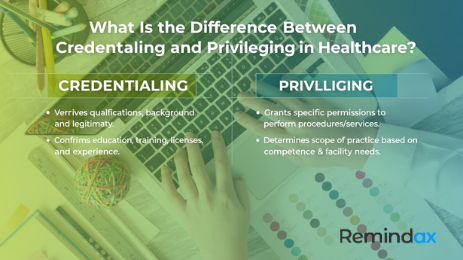
Navigating the complexities of healthcare administration can be challenging, especially when faced with industry-specific processes like credentialing and privileging. These are more than just administrative tasks-they are vital safeguards that protect patient safety, ensure compliance with regulatory standards, and maintain the integrity of healthcare organizations. Misunderstanding these processes can lead to serious consequences, including compliance violations, compromised patient care, and operational inefficiencies.
This comprehensive guide will demystify credentialing and privileging, highlighting their key differences, step-by-step processes, benefits, challenges, and how automation tools like Remindax can streamline them. By the end, you’ll have actionable insights to improve your workflows and ensure healthcare excellence.
Credentialing vs. Privileging: Key Concepts at a Glance
Understanding the distinction between credentialing and privileging is critical for healthcare administrators, HR teams, and medical staff. While both processes are essential, they serve different purposes:
| Feature | Credentialing | Privileging |
| Purpose | Verifies a provider’s qualifications | Grants authority to perform specific procedures |
| Scope | Broad, general qualifications | Narrow, procedure-specific competencies |
| Timing | Conducted before employment or affiliation | Conducted after credentialing, updated periodically |
| Oversight | HR or credentialing committees | Medical staff office or department heads |
| Regulatory Focus | Compliance with state and accreditation requirements | Compliance with internal policies and patient safety standards |
| Renewal | Every 2-3 years (varies) | Regularly, or whenever roles/procedures change |
Both processes work together to ensure that only qualified and competent providers deliver care, and understanding their differences is the first step toward improving healthcare quality and safety.
What is Credentialing?
Credentialing is the process of evaluating and verifying a healthcare provider’s qualifications, education, training, licenses, certifications, and work history. It ensures that providers meet established standards and are capable of delivering safe, high-quality care.
Key Features of Credentialing
- Education Verification: Confirming degrees, diplomas, and completed training programs.
- License and Certification Assessment: Ensuring all professional licenses and certifications are current and valid.
- Work History Review: Examining past employment, references, and any disciplinary actions.
- Ongoing Monitoring: Tracking updates in certifications, licenses, and continuing education.
- Re-Credentialing: Periodically updating and revalidating credentials to maintain compliance.
Step-by-Step Credentialing Process
1. Application Submission
- Providers complete a detailed application with education, work experience, certifications, licenses, and references. Accuracy is essential, as small errors can delay the process.
2. Primary Source Verification (PSV)
- Credentialing teams verify credentials directly with institutions, boards, and previous employers to ensure authenticity.
3. Background and Malpractice Checks
- Legal, criminal, and malpractice history are reviewed to assess risk and maintain patient safety.
4. Committee Review and Approval
- Credentialing committees review the verified information and make recommendations for approval, ensuring alignment with organizational standards.
5. Ongoing Monitoring
- Providers’ credentials are continuously tracked for expiration dates, renewals, and updates to maintain compliance.
6. Re-Credentialing
- Typically conducted every 2-3 years, re-credentialing ensures that providers’ qualifications remain current and valid.
Benefits of Credentialing
- Ensures Regulatory Compliance: Aligns with state, federal, and accreditation standards.
- Enhances Patient Safety: Confirms that only qualified professionals provide care.
- Boosts Organizational Credibility: Builds trust among patients and peers.
- Reduces Risk of Errors: Minimizes the chance of employing underqualified providers.
Challenges in Credentialing
- Time-consuming and paperwork-heavy process.
- Risk of human error in verification or documentation.
- Tracking expiration dates manually is inefficient.
Solution: Automation tools like Remindax centralize credentialing data, track renewals, and reduce human error, making the process faster, easier, and more reliable.
What is Privileging?
Privileging grants healthcare providers the authority to perform specific procedures within a facility. It builds on credentialing by evaluating providers’ competencies and aligning them with institutional needs. While credentialing verifies qualifications, privileging ensures that providers can safely and effectively perform defined clinical tasks.
Key Features of Privileging
- Competency Assessment: Evaluates specific clinical skills for requested procedures.
- Procedure-Specific Permissions: Grants authorization for specific tasks, such as surgeries or advanced diagnostics.
- Regular Reviews: Ensures privileges remain aligned with skills, experience, and patient safety standards.
Step-by-Step Privileging Process
1. Submission of Privileging Application
- Providers list the procedures they wish to perform and submit supporting documentation, such as certifications, case logs, and references.
2. Verification of Qualifications
- The provider’s training, education, and experience are verified to ensure competency for the requested procedures.
3. Competency Assessment
- Peer reviews, case studies, and performance evaluations are conducted to confirm skills and readiness.
4. Alignment with Organizational Needs
- Requested privileges are compared with the facility’s resources and needs to ensure safety and feasibility.
5. Committee Review
- Medical staff committees review the application and supporting documents to approve privileges.
6. Approval and Granting of Privileges
- Privileges are formally granted, allowing the provider to perform specific procedures within the organization.
7. Monitoring and Ongoing Evaluation
- Providers are regularly monitored for performance, patient outcomes, and compliance with procedures.
8. Re-Privileging
- Privileges are re-evaluated periodically to ensure continued competence and alignment with institutional needs.
Benefits of Privileging
- Ensures that providers are qualified for specific procedures.
- Maintains patient safety by aligning skills with responsibilities.
- Supports compliance with accreditation and internal policies.
- Reduces operational risks from unqualified practice.
Challenges in Privileging
- Tracking competency and privileges manually is error-prone.
- Privileges may need frequent adjustments based on provider skills or organizational changes.
Solution: Tools like Remindax automate privileging tracking, send reminders for renewals, and maintain a centralized dashboard for all provider privileges.
Credentialing vs. Privileging: Detailed Comparison
| Aspect | Credentialing | Privileging |
| Purpose | Verifies qualifications | Grants procedure-specific authority |
| Process | Verification of education, licenses, work history | Evaluation of competencies and alignment with roles |
| Scope | Broad, general qualification | Narrow, procedure-specific |
| Timing | Completed before employment or affiliation | Conducted after credentialing, ongoing |
| Oversight | HR or credentialing committees | Medical staff committees |
| Regulatory Focus | Compliance with state boards, accreditation bodies | Aligns with internal facility policies |
| Renewal | Every 2-3 years | More frequent or as roles change |
By understanding these differences, healthcare organizations can maintain high standards of care and avoid compliance pitfalls.
How Automation Simplifies Credentialing and Privileging
Manual processes in credentialing and privileging are time-consuming, prone to errors, and often inefficient. Automation provides several key benefits:
- Reduced Errors
Automated systems track expirations, certifications, and privileges, eliminating missed deadlines. - Time Savings
Staff spend less time on repetitive tasks, freeing them to focus on patient care and quality improvement. - Centralized Data Management
All credentials and privileges are stored in one secure platform, improving visibility and audit readiness. - Compliance Made Easy
Automated reminders and dashboards ensure organizations stay compliant with regulatory and accreditation requirements.
Example: Healthcare organizations using Remindax can automate credentialing and privileging workflows, track renewals, monitor competency, and generate audit-ready reports effortlessly.
Best Practices for Credentialing and Privileging
- Standardize Processes
Create clear policies and procedures for both credentialing and privileging to avoid confusion and delays. - Conduct Regular Audits
Periodically review credentialing and privileging records to ensure compliance and address gaps. - Train Staff
Ensure all staff understand the processes, their responsibilities, and the importance of accurate documentation. - Leverage Automation
Use tools like Remindax to reduce manual work, minimize errors, and maintain compliance efficiently. - Maintain Documentation
Keep complete, organized records for audit purposes and internal reviews.
Future Trends in Credentialing and Privileging
- AI-Assisted Credential Verification
Artificial intelligence can automate verification processes, identify discrepancies, and flag issues before they become compliance risks. - Predictive Privileging
Data-driven insights may help predict which providers are likely to need additional training or adjustments to privileges. - Telehealth Considerations
As remote healthcare grows, credentialing and privileging processes are adapting to virtual environments. - Integration Across Systems
Integration with electronic health records (EHRs) and HR systems will further streamline workflows.
Streamline Credentialing and Privileging for Patient Safety and Compliance
Credentialing and privileging are essential for ensuring compliance, patient safety, and operational efficiency in healthcare. While credentialing verifies provider qualifications, privileging grants authority for specific procedures based on competence and organizational needs.
Implementing automation tools like Remindax can simplify workflows, reduce errors, save time, and maintain audit-ready compliance. By understanding the differences, following best practices, and leveraging technology, healthcare organizations can deliver safe, high-quality care while minimizing risk and improving operational efficiency.
Take action today: Streamline your credentialing and privileging processes with Remindax and ensure your healthcare organization stays compliant, efficient, and patient-focused.
Frequently Asked Question
1. What is credentialing in healthcare?
Credentialing is the process of verifying a healthcare professional’s qualifications. Hospitals and healthcare organizations check education, training, licenses, certifications, and work history to confirm that a provider is qualified to practice. This process helps ensure patient safety and regulatory compliance.
2. What is privileging in healthcare?
Privileging is the process of granting a healthcare provider permission to perform specific procedures or services within a healthcare facility. After credentialing verifies the provider’s qualifications, privileging determines what clinical tasks or treatments they are allowed to perform.
3. What is the main difference between credentialing and privileging?
The main difference is their purpose. Credentialing verifies a provider’s qualifications and professional background, while privileging determines the specific medical procedures or services the provider can perform at a healthcare organization.
4. Why are credentialing and privileging important in healthcare?
Both processes are important for maintaining patient safety, ensuring compliance with healthcare regulations, and protecting healthcare organizations from legal risks. They help confirm that only qualified professionals deliver medical care.
5. Who is responsible for credentialing and privileging?
Credentialing and privileging are usually handled by a hospital’s medical staff office, credentialing committee, or human resources department. These teams review documentation, verify credentials, and approve privileges based on the provider’s experience and skills.
6. How often do credentialing and privileging need to be renewed?
Most healthcare organizations require credentialing and privileging to be renewed every two to three years. This re-evaluation ensures that healthcare providers maintain valid licenses, certifications, and current clinical competence.
7. Can a provider be credentialed but not privileged?
Yes. A healthcare provider may pass the credentialing process but may not receive privileges for certain procedures. Privileges are granted only if the provider has the required training, experience, and demonstrated competency for those specific services.