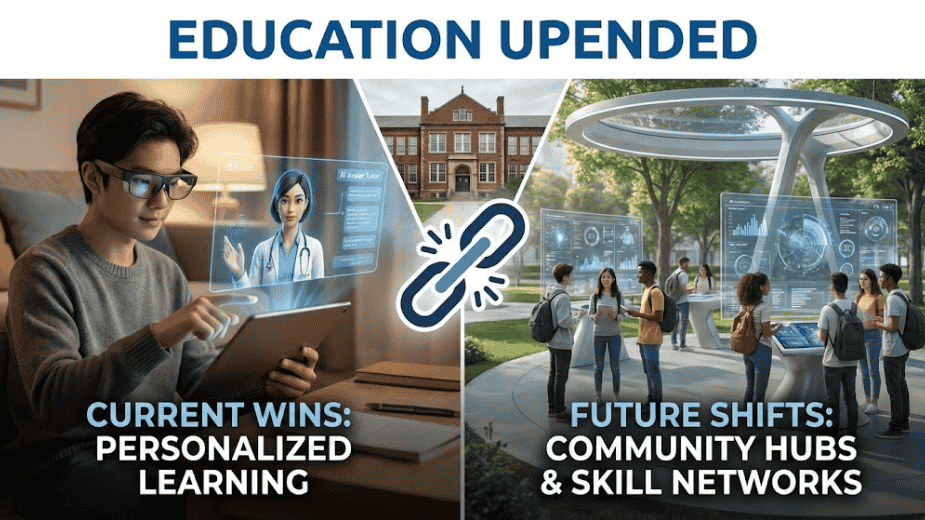
The education landscape is experiencing a seismic shift as artificial intelligence tutors emerge from experimental labs into millions of classrooms and homes worldwide. While the notion of schools becoming “obsolete” remains hotly debated, there’s no denying that AI tutoring systems are fundamentally reshaping how students learn, teachers teach, and institutions operate.
The Current State of AI Tutoring
The AI tutoring industry is experiencing explosive growth. The global market was valued at $1.63 billion in 2024 and is projected to reach $7.99 billion by 2030, expanding at a compound annual growth rate of 30.5% Grand View Research. This rapid expansion reflects a fundamental transformation in how education is delivered and consumed worldwide.
Market Overview: The Numbers Tell the Story
| Market Metric | 2024 Value | 2030 Projection | Growth Rate |
| Global AI Tutors Market | $1.63 billion | $7.99 billion | 30.5% CAGR |
| Global AI in Education | $5.88 billion | $32.27 billion | 31.2% CAGR |
| North America Market Share | 35-38% | Growing | Leading region |
| K-12 Segment Share | 45.6% | Expanding | Dominant sector |
| Subject-Specific Tutoring | 50%+ of revenue | Growing | Top application |
| Cloud-Based Solutions | 71.2% | Expanding | Preferred deployment |
Current Wins: Where AI Tutoring Shines
1. Personalized Learning at Scale
Advanced language models now deliver comprehension gains of up to 40% over traditional e-learning tools through subject-specific conversations that mirror Socratic tutoring methods Mordor Intelligence. Unlike traditional classrooms where one teacher manages 25-30 students, AI tutors adapt to each student’s pace, learning style, and knowledge gaps in real-time.
2. Improved Learning Outcomes
Recent research provides compelling evidence of AI tutoring effectiveness. A randomized controlled trial found that college students learned significantly more in less time using an AI tutor compared to in-class active learning, while also reporting higher engagement and motivation Nature. The study demonstrates that well-designed AI tutors can match or exceed traditional teaching methods.
3. Accessibility and Affordability
AI tutors offer scalable solutions that significantly reduce operational costs for educational institutions compared to traditional tutoring methods Grand View Research. This democratization of quality education is particularly impactful in developing regions where teacher shortages persist.
4. 24/7 Availability
Unlike human tutors bound by schedules and time zones, AI tutoring systems provide round-the-clock support. Students can access help during late-night study sessions, early mornings, or whenever questions arise, removing temporal barriers to learning.
5. Data-Driven Insights
AI systems collect and analyze vast amounts of learning data, identifying patterns that help educators understand student struggles, predict dropout risks, and design targeted intervention strategies. This evidence-based approach enables more informed educational decision-making.
Real-World Adoption: Who’s Using AI Tutors?
Education Sector Leadership
In November 2024, IEMA Research & Development launched an AI Tutor platform that personalizes education by adapting to users’ learning pace, offering tailored pathways for mastering subjects like AI coding and Python Grand View Research. Major educational publishers are also entering the space-Pearson announced generative AI-powered tools in July 2024 that create personalized learning experiences and embed AI tutors in videos to answer concept-related questions Grand View Research.
Global Government Support
Germany’s Digitalpakt 2.0 earmarks €6.5 billion for AI-enabled classroom tools, while Canada’s CanCode program subsidizes intelligent tutoring for underserved learners Mordor Intelligence. India’s National Education Policy mandates AI integration by 2030, creating a domestic market exceeding $2.8 billion Grand View Research.
Corporate Training Revolution
McKinsey research reveals that 87% of companies face skill gaps as AI transforms workflows, driving training budgets toward personalized, just-in-time AI tutoring platforms Mordor Intelligence. Corporations leverage these systems to shorten certification cycles and reduce onboarding costs.
The Effectiveness Debate: What Research Shows
The scientific community has conducted extensive research on AI tutoring effectiveness, revealing nuanced findings:
Positive Outcomes
A systematic review of intelligent tutoring systems in K-12 education found that effects on learning and performance are generally positive, though results vary when compared to non-intelligent digital systems Nature. Longitudinal studies of algebra tutoring in urban high schools showed significant improvements in standardized test scores that were sustained over multiple academic years arXiv.
Important Caveats
Not all AI tutoring delivers equal results. Research by Zhai and colleagues found that regular use of AI dialogue systems was associated with declines in students’ cognitive abilities and information retention due to “cognitive offloading”-students passively accepting AI outputs rather than engaging critically NHSJS.
However, thoughtful implementation makes the difference. A study in Ghana found that limiting WhatsApp-based chatbot AI tutoring to two 30-minute sessions weekly yielded significant math score improvements without cognitive ability loss NHSJS.
Future Shifts: What’s Coming Next?
1. Hybrid Human-AI Models
The future isn’t about replacing teachers but augmenting them. AI serves as a tool for educators, providing personalized insights and adapting teaching strategies in real-time, while teachers leverage AI-derived insights to adjust their instructional methodologies NORC. This “one-size-fits-one” approach combines the best of both worlds.
2. Multimodal Learning Experiences
As AI models improve, future systems will interpret images and audio of student work, providing more proactive feedback on thinking processes beyond what current pedagogies offer PubMed Central. Expect AI tutors that can analyze handwritten work, verbal explanations, and even facial expressions to gauge understanding.
3. Regional Expansion in Asia-Pacific
The Asia-Pacific region is poised for the fastest growth, with an expected compound annual growth rate of 34.1% from 2025 to 2033, fueled by large student populations, rising digital education investments, and government initiatives modernizing educational infrastructure Dataintelo.
4. Affective Computing Integration
Next-generation systems will incorporate emotional intelligence, recognizing student frustration, confusion, or disengagement and adjusting their approach accordingly. This emotional awareness enhances effectiveness and creates more supportive learning experiences.
5. Corporate Skills Development
As automation reshapes job markets, AI tutoring will become essential for workforce reskilling. Enterprises will increasingly deploy these systems for just-in-time learning, embedding practice simulations within everyday productivity applications.
Challenges Ahead
Privacy and Compliance
Updated COPPA rules require granular parental consent for behavioral data used in AI personalization, increasing onboarding friction and raising legal costs by 35% among K-12-focused vendors Mordor Intelligence. European GDPR oversight forces data-minimization techniques that may impact model accuracy.
Language and Cultural Barriers
English-centric datasets dominate most AI tutor models, leading to diminished accuracy in languages like Hindi, Arabic, and Swahili, perpetuating learning inequality as smaller linguistic markets cannot justify translation economics Mordor Intelligence.
Avoiding Over-Reliance
Educators and parents must monitor usage to prevent cognitive offloading. The goal is active engagement with AI as a learning partner, not passive consumption of AI-generated answers.
Are Schools Really Becoming Obsolete?
While the headline suggests schools face obsolescence, the reality is more nuanced. AI tutors excel at personalized instruction, immediate feedback, and scalable access—but schools provide irreplaceable social development, collaborative learning, mentorship, and the human connections that shape well-rounded individuals.
The future likely holds a transformed educational ecosystem where:
- Traditional schools evolve to focus on collaboration, critical thinking, and social-emotional learning
- AI tutors handle personalized skill acquisition and knowledge mastery
- Teachers transition from knowledge deliverers to facilitators, mentors, and learning designers
- Students benefit from the best of both worlds—human wisdom and AI-powered personalization
Key Takeaways
- The AI tutoring market is experiencing extraordinary growth, projected to reach nearly $8 billion by 2030
- Well-designed AI tutors demonstrate measurable improvements in learning outcomes, engagement, and efficiency
- Government support worldwide is accelerating adoption, particularly in developed nations and rapidly growing Asian markets
- Effectiveness depends heavily on implementation—structured, limited engagement prevents cognitive offloading
- The future is hybrid: AI augmenting human teachers rather than replacing them
- Challenges around privacy, language diversity, and equitable access require ongoing attention
Rather than making schools obsolete, AI tutoring is catalyzing an educational revolution-one where technology and humanity collaborate to create more personalized, accessible, and effective learning experiences for all.
Frequently Asked Questions
1. What are AI tutors?
AI tutors are smart software programs that use artificial intelligence to teach students. They give lessons, explain topics, answer questions, and provide practice tests. They can adjust learning based on a student’s level.
2. How are AI tutors changing education today?
AI tutors offer personalized learning. Students can learn at their own speed, get instant feedback, and study anytime. This makes learning more flexible and accessible.
3. Can AI tutors replace traditional schools?
Right now, AI tutors cannot fully replace schools. Schools also provide social interaction, teamwork, discipline, and emotional support. AI tutors support learning, but they do not replace human teachers completely.
4. What are the main benefits of AI tutors?
- 24/7 availability
- Instant feedback
- Personalized study plans
- Lower learning costs
- Access to global resources
5. Are AI tutors better than human teachers?
AI tutors are good at explaining topics and giving practice. But human teachers provide motivation, emotional understanding, and classroom management. Both can work together for better results.
6. Do AI tutors improve student performance?
Many students improve because AI tools adapt to their strengths and weaknesses. They focus more on weak areas and provide extra practice where needed.
7. What are the risks of relying too much on AI tutors?
Overuse may reduce face-to-face interaction. Students might depend too much on technology. There are also concerns about data privacy and screen time.
8. How affordable are AI tutors?
Many AI learning tools are cheaper than private tutors. Some offer free versions, while others use monthly subscriptions.
9. What does the future of AI in education look like?
In the future, AI tutors may become more advanced. They may use voice interaction, virtual reality, and real-time emotion detection to improve learning experiences.
10. Will schools disappear in the future?
It is unlikely that schools will completely disappear. Instead, education may become a mix of traditional classrooms and AI-powered learning tools.