Somewhere in your organization right now, a contract is quietly approaching its expiration date. It could be a vendor agreement with a buried auto-renewal clause. It could be an insurance policy awaiting updated documentation. It could be a software license that your entire team depends on every single day. The contract does not know your team is busy. It does not wait for a convenient moment. It just expires.
The question is not whether you have contracts expiring – every business does. The question is whether your team knows about them in time to act. For companies that treat contract expiration tracking as an afterthought, the answer is almost always no. And the consequences range from mildly inconvenient to genuinely catastrophic.
This guide explores why contract expiration tracking deserves a permanent seat at the center of your business operations – and how Remindax, a purpose-built contract expiration tracking platform, helps organizations of all sizes take full control of their contract lifecycle before critical deadlines are missed.
What Is Contract Expiration Tracking?
Contract expiration tracking is the systematic practice of monitoring the end dates of all active agreements your organization holds – and taking deliberate, proactive steps well before those dates arrive. It sounds straightforward. In practice, it is one of the most consistently overlooked operational responsibilities in business.
The scope of contracts that require tracking is broader than most organizations realize. It includes:
• Vendor and supplier agreements
• Insurance policies and certificates of coverage
• Commercial real estate leases and equipment rental agreements
• Software and technology licenses
• Service-level agreements (SLAs) with clients and providers
• Employment contracts, NDAs, and consulting agreements
• Regulatory permits, certifications, and compliance documents
• Partnership and distribution agreements
Effective contract expiration tracking goes well beyond simply writing down a date. It means understanding the renewal terms for each contract, knowing exactly how much lead time is required before the notice window closes, assigning clear ownership to each agreement, and having automated systems in place to ensure nothing slips through the cracks as teams grow and priorities shift.
At its core, contract expiration tracking is about two things: visibility and control. When you can see what is expiring and when – weeks or months before it happens – you make deliberate decisions instead of reacting to emergencies.
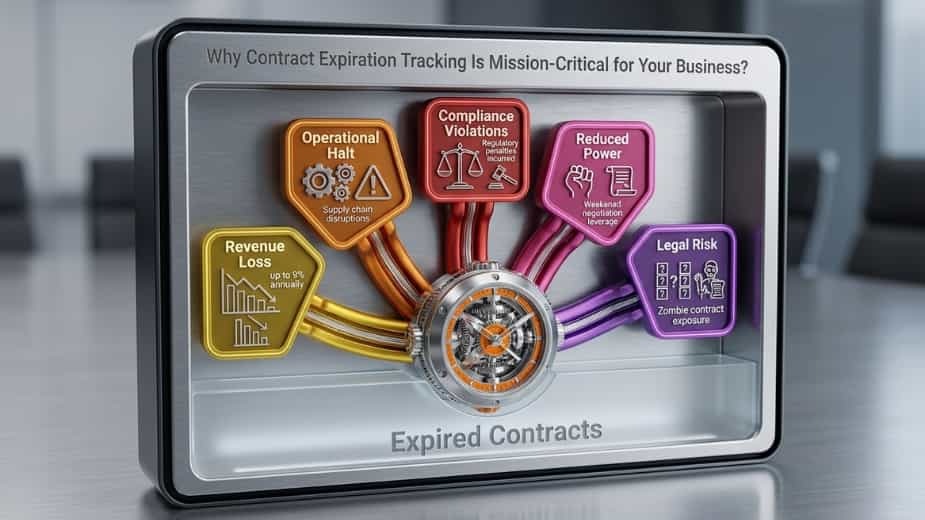
Why Contract Expiration Tracking Is Mission-Critical
1. It Directly Protects Your Revenue
Poor contract management is not just an administrative inconvenience – it is a measurable financial liability. Industry research consistently estimates that organizations lose up to 9% of annual revenue through missed renewals, unfavorable auto-renewals, and poorly managed contract obligations. Globally, that translates to an estimated $50 billion lost every year across businesses of all sizes.
The financial fallout from an expired or mismanaged contract takes several forms:
• Emergency procurement at premium rates when a vendor agreement lapses and operations must continue
• Automatic renewal at inflated pricing when notice windows are missed
• Service interruptions that halt revenue-generating activities while alternatives are sourced
• Penalty clauses triggered by late termination or non-renewal notices
Every one of these scenarios is preventable. Remindax eliminates blind spots by delivering automated, tiered alerts at 180, 90, 60, and 30 days before expiration – giving your team the time they need to evaluate, negotiate, and act before the financial damage is done.
2. It Ensures Uninterrupted Operations
Many of the contracts your organization holds are not optional – they are the foundation your daily operations run on. When these agreements lapse without warning, the operational consequences can be immediate and severe.
Consider what breaks when a single contract expires unnoticed:
• Software licenses expire and entire teams lose access to critical tools overnight
• Vendor agreements lapse and supply chains stall, delaying production and fulfillment
• Equipment maintenance contracts end and a breakdown has no service coverage
• SLAs with clients expire without renewal, creating ambiguity about obligations and accountability
In industries like healthcare, manufacturing, construction, and logistics, a single expired contract can halt operations entirely. These are not edge cases – they are common outcomes when tracking systems fail. Remindax provides a centralized dashboard that gives operations leaders a real-time view of every upcoming renewal across the organization, so nothing reaches expiration without a decision being made.
3. It Keeps You Compliant and Audit-Ready
In regulated industries, expired contracts do not simply create operational inconvenience. They create compliance violations that carry real consequences – fines, corrective action plans, loss of certifications, and in serious cases, suspension of operations.
Healthcare organizations must maintain current vendor agreements and insurance coverage to satisfy Joint Commission standards and CMS requirements. Construction companies need active insurance policies, bonding, and permits to comply with OSHA regulations and project owner requirements. Financial services firms face regulatory penalties for operating under expired licensing or vendor agreements. Professional services organizations must keep their liability and indemnification coverage current to remain eligible for contracts.
Regulatory auditors do not accept “we are working on it” as an answer. When an audit begins, you need to provide proof of current, properly documented agreements – immediately. Remindax maintains a complete, searchable contract repository with renewal histories, notification logs, and document attachments, giving compliance officers instant audit readiness at any point in time.
4. It Preserves and Strengthens Your Negotiating Position
One of the most strategically valuable – and most underappreciated – benefits of proactive contract tracking is the negotiating leverage it gives you at renewal time. When you know a contract is approaching expiration with sufficient lead time, you have the opportunity to evaluate alternatives, collect competitive bids, assess your current vendor’s performance against benchmarks, and enter renewal discussions from a position of genuine choice.
Without that lead time, you are negotiating under duress. The vendor knows you need continuity. Your leverage evaporates. Auto-renewal clauses are specifically designed to exploit this dynamic – if you miss the notice window, you are locked into whatever terms the contract specifies, often at rates 10 to 40 percent higher than you could have negotiated with proper preparation.
Remindax ensures your team never misses a negotiation window by surfacing renewal opportunities months in advance – with enough time to run a proper evaluation, engage alternatives, and close a deal that actually serves your interests.
5. It Eliminates Dangerous Legal and Financial Exposure
When a contract expires and both parties continue operating as if nothing has changed, legal professionals call the result a “zombie contract” – an agreement that has technically ended, but whose implied terms remain in effect in an undefined, legally ambiguous form. Enforcing obligations under a zombie contract is difficult. Defending against claims under one is even harder.
The most dangerous category of expired contracts involves insurance. If an incident occurs during even a brief coverage gap – a workplace injury, a property loss, a professional liability claim – the organization is fully exposed. Insurance carriers have no obligation to cover incidents that fall outside the active policy period. Even a gap of a few days can result in catastrophic financial liability that far exceeds the cost of any renewal.
Remindax treats insurance renewals with the same urgency as any other mission-critical contract – with automated reminders, document storage, and designated ownership – so coverage gaps never happen by accident.
Industry-Specific Use Cases: Where Contract Expiration Tracking Matters Most
Healthcare and Medical Organizations
Healthcare organizations operate in one of the most contract-dense regulatory environments in existence. Beyond standard vendor and service agreements, healthcare providers must maintain current documentation for medical supply contracts, lab service agreements, accreditation requirements, malpractice and liability policies, and HIPAA Business Associate Agreements (BAAs).
A single lapsed BAA with a technology vendor can result in a reportable HIPAA violation, triggering investigations, fines, and mandatory breach notifications. A lapsed malpractice policy creates exposure on every patient interaction until coverage is restored. Remindax gives healthcare compliance teams a centralized, real-time view of all contract deadlines – with automated escalation to ensure the right person is notified well before any gap in coverage or compliance can occur.
Construction and Contracting
Construction firms manage a complex web of time-sensitive agreements that directly govern their ability to operate on any given project. General liability insurance, workers compensation policies, surety bonds, subcontractor agreements, project permits, and equipment leases all carry strict expiration timelines – and failure to maintain any one of them can result in project shutdowns, contract terminations, and regulatory violations.
For construction companies bidding on public projects or working with large general contractors, proof of current insurance and bonding is a standard prerequisite. A lapsed certificate of insurance discovered during a pre-qualification review can disqualify a firm from an entire contracting opportunity. Remindax allows construction operations teams to track every policy and permit across every active project, with reminders calibrated to the notice windows that matter most.
Technology and SaaS Companies
Technology companies live and die by their software dependencies. Expired software licenses, lapsed API service agreements, and missed SLA renewal windows can cause immediate, widespread disruption to product teams and customer-facing services. For companies that resell licensed technology as part of their own product stack, a vendor licensing gap can create downstream contractual liability with their own customers.
Remindax helps technology and SaaS organizations maintain a complete inventory of vendor dependencies, license agreements, and service contracts – with automated alerts that keep engineering, procurement, and legal teams aligned on what is coming due and what decisions need to be made.
Professional Services and Consulting
Law firms, accounting firms, management consultancies, and other professional services organizations carry significant contract obligations that directly affect their ability to serve clients. Professional indemnity insurance, errors and omissions (E&O) policies, engagement letters, retainer agreements, and non-disclosure agreements all require active tracking and timely renewal.
A lapsed E&O policy discovered during a client audit or claim can expose the firm to liability that exceeds the value of the engagement many times over. Remindax provides professional services firms with the visibility and accountability structure they need to ensure that every client-facing obligation and every insurance coverage requirement is managed with the same discipline applied to client work itself.
Real Estate and Property Management
Property managers and real estate operators handle dozens of concurrent lease agreements, maintenance service contracts, insurance policies, and vendor agreements – each with its own expiration date, notice window, and renewal requirements. Missed lease renewal deadlines can result in tenant holdover situations, loss of guaranteed income, or the need to re-lease at less favorable market rates.
Remindax gives property management teams a centralized contract calendar that surfaces upcoming lease expirations, maintenance contract renewals, and insurance deadlines across an entire portfolio – with automated reminders that ensure every decision is made proactively, not reactively.
How Remindax Solves the Contract Expiration Problem
Centralized Contract Repository
Remindax provides a single, searchable hub for every contract your organization manages – regardless of which department owns it. Vendor agreements, insurance policies, leases, software licenses, employment contracts, and regulatory documents all live in one place, with full document storage, key date tracking, and renewal history. No more spreadsheets. No more tribal knowledge. No more searching through email threads to find the version of the agreement that was actually signed.
Intelligent Automated Reminders
Remindax delivers tiered, automated reminders at customizable intervals – typically 180, 90, 60, and 30 days before each contract’s expiration date. Reminders are routed to the designated contract owner and can include relevant document attachments, renewal instructions, and escalation contacts. This multi-stage notification approach ensures that time-sensitive renewals are never addressed in a last-minute panic, and that the appropriate stakeholders have time to complete any internal approval processes before the deadline arrives.
Clear Ownership and Accountability
Every contract in Remindax has a designated owner who receives notifications, tracks renewal status, and is accountable for ensuring timely action. This eliminates the “I thought someone else was handling it” dynamic that causes so many missed renewals in organizations where contract responsibility is informally distributed across departments.
Real-Time Dashboard and Reporting
Remindax’s dashboard gives leadership, legal, compliance, and operations teams an immediate, real-time view of every contract approaching expiration – sorted by urgency, department, or contract type. Reporting tools allow organizations to track renewal histories, document notification records, and demonstrate proactive contract management practices to auditors, insurers, and board members.
Document Storage and Version Control
Remindax stores the actual contract documents alongside their tracking records – including amendments, renewal letters, certificate updates, and correspondence. When an auditor asks for proof of active coverage or a current vendor agreement, your team can retrieve and produce the documentation in seconds, not hours.
Scalability Across Departments and Entities
Whether your organization manages 50 contracts or 5,000 – across a single office or multiple subsidiaries – Remindax scales to match your complexity. Contracts can be organized by department, entity, location, or contract type, with role-based permissions that ensure the right people have access to the right information without exposing sensitive agreements across the entire organization.
Common Scenarios Where Contract Tracking Breaks Down – and How Remindax Prevents Them
The Spreadsheet Nobody Updates
Research shows that approximately 33% of businesses still track contract expiration dates manually, and 9% do not track them at all. The typical pattern is familiar: a spreadsheet is created during a cleanup initiative, maintained diligently for a few months, and then gradually neglected as daily priorities crowd out administrative tasks. By the time someone remembers to check it, several contracts have already expired or auto-renewed on unfavorable terms.
Remindax replaces the spreadsheet with a living, automated system that does not depend on anyone remembering to check it. Reminders go out automatically. Deadlines are surfaced proactively. Nothing slips through.
The Staff Transition That Drops the Ball
When the person responsible for managing a contract changes roles, takes extended leave, or leaves the organization, the institutional knowledge about what is due and when often leaves with them. If contract information lives in their email, their personal files, or their memory, the organization is left scrambling to reconstruct the picture before something expires.
Remindax maintains all contract information in a centralized, organization-owned system – not in any individual’s inbox. Ownership can be reassigned instantly, and all notification history, document records, and renewal notes are preserved through any personnel transition.
The Auto-Renewal Trap
Auto-renewal clauses are designed to ensure continuity, but they work against you when they go unmonitored. A contract that auto-renews at a 20 to 40 percent premium because no one caught the notice window represents real money lost – and it compounds across every contract in your portfolio. Multiply that across dozens of vendor agreements over several years, and the cumulative financial impact is substantial.
Remindax surfaces auto-renewal dates and notice windows as first-class data points for every contract. Your team knows exactly when the window closes – and receives automated reminders long before it does.
The Compliance Audit You Were Not Ready For
Regulatory audits frequently require organizations to produce proof of current, active contracts with vendors, insurers, and service providers on short notice. Organizations without a centralized tracking system routinely discover documentation gaps only when the auditor is already on site. By then, the damage is done – findings are issued, corrective action plans are required, and in some cases, fines are levied.
Remindax gives compliance teams immediate access to the documentation they need, with renewal histories and notification logs that demonstrate proactive management practices – not reactive scrambling.
How to Build a Mission-Critical Contract Tracking System
Step 1: Centralize Every Contract Across Every Department
The first step is establishing a single source of truth for all active contracts – not just the ones managed by legal or procurement, but every agreement held by every department. Vendor contracts, IT licenses, HR agreements, real estate leases, insurance policies, and regulatory permits all belong in the same system. Remindax is built for this kind of cross-functional consolidation, with flexible categorization and role-based access that supports departmental autonomy within a unified view.
Step 2: Record Key Dates and Terms at Signing
For every contract entered into Remindax, capture the start date, end date, renewal notice period, auto-renewal terms, and any special conditions or renewal requirements. This information should be recorded at the time the contract is signed – not weeks later when someone realizes a deadline is approaching. Remindax makes this intake process straightforward, with structured fields for all key contract data and document attachment capabilities.
Step 3: Configure Automated, Tiered Reminders
Best practice is to configure tiered reminders starting at 180 days for complex, high-value contracts and at minimum 90 days for simpler agreements. Remindax allows organizations to customize notification schedules by contract type, value, or department – ensuring that the team managing a multi-year enterprise software agreement gets significantly more lead time than the team managing a routine office supply contract.
Step 4: Assign Clear Ownership to Every Contract
Every contract in Remindax must have a designated owner: a specific person who is responsible for monitoring its status, initiating the renewal process, completing required documentation, and escalating to leadership when decisions need to be made. Without explicit ownership, even the best tracking system will produce alerts that no one acts on.
Step 5: Build a Regular Review Cadence
Beyond automated reminders, build a quarterly review process where a cross-functional team – including representatives from legal, finance, procurement, and operations – reviews upcoming renewals, evaluates contract performance, and makes strategic decisions about what to renew, renegotiate, or terminate. Remindax’s reporting tools make this process fast and data-driven, turning contract management from a reactive exercise into a source of genuine strategic value.
Frequently Asked Questions
What makes contract expiration tracking “mission-critical”?
Contract expiration tracking is mission-critical because it directly affects your ability to operate, comply with regulations, protect your financial position, and manage legal risk. A single missed renewal can halt services, trigger compliance violations, expose the organization to uninsured liability, or lock it into years of unfavorable financial terms. The consequences compound across every contract that goes unmanaged.
How many contracts does a typical mid-sized business manage?
A mid-sized business typically manages between 50 and several hundred active contracts at any given time, spanning vendor agreements, insurance policies, leases, software licenses, employment agreements, and regulatory documents. The more contracts you manage, the higher the probability that something will expire without action – unless you have a structured, automated tracking system in place.
What is the biggest risk of not tracking contract expiration dates?
The most common high-impact failures are insurance coverage gaps (which leave the organization fully liable for incidents), unfavorable auto-renewals (which inflate costs across the contract portfolio), and compliance violations (which trigger audits, fines, and corrective action plans). All three are entirely preventable with proper tracking – and all three are addressed directly by Remindax.
Can small businesses benefit from contract expiration tracking?
Absolutely – and small businesses are often more vulnerable to the consequences of a missed renewal, not less. A small organization has fewer resources to absorb unexpected emergency procurement costs, less negotiating leverage to recover from an unfavorable auto-renewal, and a smaller team where a single person’s oversight can affect every department. Remindax is designed to be accessible and practical for organizations of any size.
How does Remindax support audit readiness?
Remindax maintains a complete, searchable contract repository with attached documents, renewal histories, and notification logs that demonstrate proactive management practices. When an auditor requires proof that key contracts are current and properly documented, Remindax allows compliance officers to retrieve and produce that documentation immediately – not after a frantic search through multiple systems and email threads.
What types of contracts should be tracked in Remindax?
Every contract with an expiration or renewal date should be tracked. This includes vendor and supplier agreements, insurance policies, real estate leases, software and technology licenses, service-level agreements, employment contracts, consulting agreements, NDAs, partnership agreements, and any regulatory permits or certifications tied to business operations. If it has an expiration date, it belongs in Remindax.
How far in advance should renewal reminders be set?
Best practice is to set tiered reminders starting at 180 days before expiration for complex, high-value, or insurance-related contracts, and at minimum 90 days for simpler agreements. This provides adequate time for review, competitive evaluation, internal approval, negotiation, and documentation – without the pressure of an imminent deadline. Remindax allows organizations to fully customize reminder schedules by contract type, value, or department.
What is the difference between contract management and contract expiration tracking?
Contract management encompasses the full lifecycle of an agreement – from drafting, negotiation, and execution through performance monitoring and eventual termination. Contract expiration tracking focuses specifically on monitoring end dates, renewal deadlines, and notice windows to ensure timely action before contracts lapse or auto-renew on unfavorable terms. Remindax is purpose-built for this critical function, providing the automation, visibility, and accountability structure that keeps organizations proactively in control of every contract in their portfolio.
Is Remindax suitable for organizations that manage contracts across multiple departments or entities?
Yes. Remindax is designed to scale across complex organizational structures, including multi-department enterprises, holding companies, franchises, and organizations with multiple legal entities. Contracts can be organized by department, entity, or location, with role-based access controls that ensure the right people can see and manage the contracts relevant to their responsibilities – without exposing sensitive agreements across the entire organization.
Take Control of Your Contract Lifecycle with Remindax
Every contract in your organization has an expiration date. The question is never whether those dates will arrive – it is whether your team will be ready when they do. Organizations that treat contract expiration tracking as a mission-critical business function protect their revenue, maintain uninterrupted operations, remain compliant, and negotiate from a position of strength. Organizations that do not pay for it in ways that are entirely preventable.
Remindax was built specifically to solve this problem – with a centralized contract repository, intelligent automated reminders, clear ownership structures, real-time reporting, and the document storage capabilities that make audit readiness effortless. Whether your organization manages 50 contracts or 5,000, Remindax gives you the visibility and control you need to ensure that no critical deadline ever catches your team off guard.
You do not need to be perfect. You just need a system that is. Start with Remindax, and make contract expiration tracking the business priority it has always deserved to be.