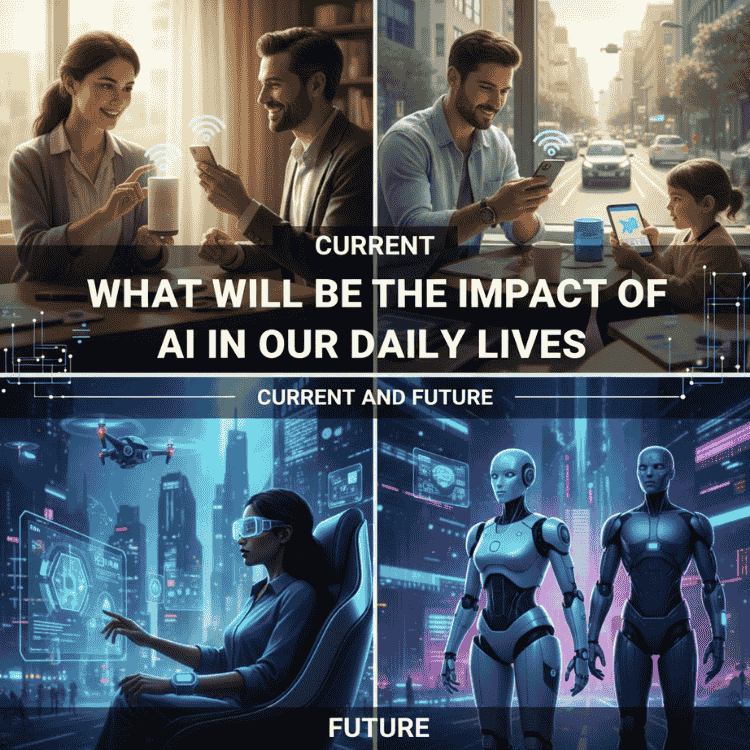
Artificial Intelligence (AI) is the ability of machines and software to think, learn, and make decisions like humans. AI systems use data, algorithms, and computing power to perform tasks that normally require human intelligence. These tasks include learning, problem-solving, decision-making, speech recognition, and image analysis.
AI is no longer a future idea. It is already part of our daily lives. We use AI when we unlock our phones, search on Google, watch movies online, shop on e-commerce websites, or use navigation apps. Many people use AI daily without even realizing it.
According to PwC, AI could contribute up to $15.7 trillion to the global economy by 2030, making it one of the most powerful technological forces of our time
In the future, AI will become more powerful and more deeply connected to human life. It will change how we work, learn, travel, communicate, and take care of our health. This article explains the current impact of AI, its future impact, its benefits, challenges, and how AI will shape our daily lives in the coming years.
AI in Our Daily Lives Today (Current Impact)
AI in Smartphones and Personal Devices
Smartphones are one of the most common examples of AI in daily life. Almost every smartphone today uses AI in many ways.
AI helps smartphones:
- Recognize faces and fingerprints
- Improve camera quality
- Predict text while typing
- Translate languages
- Understand voice commands
Voice assistants like Siri(Apple), Google Assistant, and Amazon Alexa use AI to answer questions, set reminders, play music, and control smart devices. AI also learns user behavior and suggests apps, content, and settings based on personal usage.
AI makes smartphones smarter, faster, and more personalized.
Facts & Figures
- Over 90% of modern smartphones now include AI-powered features such as face recognition, voice assistants, and camera optimization.
- AI-based image processing can improve photo quality by up to 30–40% compared to traditional camera software.
🔹 Stats
- More than 4.5 billion people worldwide use smartphones, and most interact with AI daily without realizing it.
- Voice assistants are used by 1+ billion users globally, mainly through smartphones and smart devices.
🔹 Analysis
AI in smartphones has shifted devices from simple communication tools to personal digital assistants. Features like predictive text, smart photography, and voice commands reduce manual effort, save time, and enhance user experience. As AI models improve, smartphones are becoming more context-aware and proactive rather than reactive.
🔹 Before & After Brand Example
- Before AI (Early Smartphones): Manual camera settings, basic fingerprint locks, limited search and typing assistance.
- After AI (Modern Smartphones):
- Apple iPhones use AI for Face ID, computational photography, and Siri intelligence.
- Google Pixel phones rely heavily on AI for real-time translation, call screening, and photo enhancement.
AI in Social Media and Online Platforms
Social media platforms use AI to show relevant content to users. AI studies likes, comments, watch time, and searches to understand user interests.
AI is used for:
- Content recommendations
- Spam detection
- Face recognition in photos
- Targeted advertising
Platforms like Facebook, Instagram, TikTok, and YouTube rely heavily on AI to keep users engaged. AI decides what content appears on your feed.
Facts & Figures
- AI-driven algorithms influence over 70% of content users see on major social media platforms.
- Automated AI moderation removes millions of spam and fake accounts daily across platforms.
🔹 Stats
- YouTube reports that over 60% of watch time comes from AI-based recommendations.
- TikTok’s AI-powered feed can personalize content for new users within minutes of usage.
🔹 Analysis
AI has transformed social media from a chronological feed to a personalized content ecosystem. While this increases engagement and user satisfaction, it also raises concerns about filter bubbles and data privacy. The effectiveness of AI lies in balancing personalization with responsible content delivery.
🔹 Before & After Brand Example
- Before AI (Early Social Media): Posts appeared in time order, limited content discovery, manual moderation.
- After AI (Modern Platforms):
- Instagram uses AI for Reels recommendations and ad targeting.
- Facebook applies AI to detect harmful content and fake profiles.
- YouTube relies on AI to personalize homepages and suggested videos.
AI in Workplaces and Offices
AI has changed how businesses operate. Many companies use AI to automate tasks and improve productivity.
AI is commonly used in:
- Customer support chatbots
- Email filtering
- Data analysis
- Resume screening
- Project management
AI reduces repetitive work and saves time. Employees can focus on creative and strategic tasks instead of manual work.
Facts & Figures
- Businesses using AI report up to 40% improvement in productivity for routine office tasks.
- According to a study by Gartner, AI-powered chatbots can handle 60–70% of customer queries without human involvement.
- McKinsey reports that AI can automate up to 45% of workplace tasks.
🔹 Stats
- Around 75% of organizations worldwide now use at least one AI-based workplace tool.
- Companies using AI-driven analytics make decisions 5x faster than those relying on manual analysis.
🔹 Analysis
AI in offices has shifted work from manual execution to intelligent automation. Tasks like scheduling, reporting, and customer support are now handled in real time, allowing employees to focus on creativity, planning, and growth. However, successful AI adoption depends on proper training and ethical use.
🔹 Before & After Brand Example
- Before AI (Traditional Offices): Manual data entry, human-only customer support, time-consuming reporting.
- After AI (Modern Offices):
- Microsoft uses AI in Microsoft 365 for smart email replies and data insights.
- Google Workspace applies AI for smart suggestions, document automation, and meeting summaries.
AI in Healthcare Today
Healthcare is one of the most important areas where AI is making a strong impact. AI helps doctors and medical staff make faster and more accurate decisions.
Current uses of AI in healthcare:
- Detecting diseases through scans
- Predicting patient risks
- Managing hospital records
- Virtual health assistants
AI systems can analyze large amounts of medical data quickly. This helps in early diagnosis and better treatment.
Facts & Figures
- AI-powered diagnostic tools can match or exceed human accuracy in detecting diseases like cancer and heart conditions.
- Hospitals using AI-driven data systems reduce administrative workload by up to 30%.
🔹 Stats
- The global AI healthcare market is expected to exceed $180 billion by 2030.
- AI-assisted imaging improves diagnostic accuracy by 20–40% compared to manual analysis alone.
🔹 Analysis
AI is transforming healthcare from reactive treatment to predictive and preventive care. By analyzing patient history, scans, and real-time data, AI supports early diagnosis and personalized treatment plans. While AI enhances efficiency, final medical decisions still rely on human expertise.
🔹 Before & After Brand Example
- Before AI: Manual scan analysis, paper-based records, delayed diagnoses.
- After AI:
- Google Health uses AI for medical imaging and disease detection.
- IBM Watson Health applies AI to clinical decision support and data analysis.
- Philips Healthcare uses AI for smart imaging and patient monitoring.
AI in Education and Learning
AI is improving education systems across the world. Online learning platforms use AI to personalize learning experiences.
AI helps in:
- Personalized learning paths
- Smart tutoring systems
- Automatic grading
- Student performance tracking
Students can learn at their own pace. Teachers get support in managing classrooms and assessments.
Facts & Figures
- AI-based learning platforms can improve student engagement by up to 35%.
- Automated grading systems reduce teachers’ assessment time by 40–50%.
🔹 Stats
- The global AI in education market is expected to cross $25 billion by 2030.
- Over 60% of online learning platforms now use AI-driven personalization.
🔹 Analysis
AI is shifting education from one-size-fits-all teaching to adaptive learning models. By analyzing student performance and behavior, AI adjusts content difficulty and pace. This improves learning outcomes while allowing teachers to focus more on mentorship and creativity.
🔹 Before & After Brand Example
- Before AI: Standardized lessons, manual grading, limited student insights.
- After AI:
- Coursera uses AI to recommend courses and personalize learning paths.
- Duolingo applies AI for adaptive language learning and progress tracking.
- Google Classroom uses AI to assist with assignments and analytics.
AI in Shopping and E-commerce
E-commerce platforms use AI to improve customer experience and increase sales.
AI is used for:
- Product recommendations
- Price optimization
- Inventory management
- Customer support
When users shop online, AI suggests products based on browsing and purchase history.
Facts & Figures
- AI-powered recommendations can increase e-commerce sales by 20–30%.
- Businesses using AI for inventory management reduce stock shortages by up to 35%.
🔹 Stats
- Around 80% of online shoppers are more likely to buy from platforms that offer personalized experiences.
- AI-driven pricing tools help retailers respond to market changes in real time.
🔹 Analysis
AI has changed e-commerce from basic online stores to intelligent shopping experiences. Personalized recommendations, dynamic pricing, and automated support improve customer satisfaction while helping businesses maximize revenue and efficiency.
🔹 Before & After Brand Example
- Before AI: Generic product listings, fixed pricing, manual customer support.
- After AI:
- Amazon uses AI for product recommendations, demand forecasting, and smart pricing.
- Alibaba applies AI for personalized shopping and inventory optimization.
- Shopify integrates AI tools for store analytics and customer engagement.
AI in Transportation and Navigation
AI plays a key role in modern transportation systems.
Examples include:
- GPS navigation apps
- Traffic prediction
- Ride-sharing apps
- Self-driving car research
AI helps reduce travel time and improve safety.
Benefits of AI in Daily Life
AI brings many benefits that improve the quality of life for individuals and businesses.
1. Time Efficiency
AI can perform tasks much faster than humans. Repetitive or data-heavy processes that might take hours for a person can be completed by AI in minutes, freeing up valuable time for employees to focus on more strategic work.
2. Enhanced Accuracy
AI minimizes human errors, particularly in tasks involving large datasets or complex calculations. By reducing mistakes, businesses can improve reliability, maintain higher standards, and avoid costly errors.
3. Round-the-Clock Availability
Unlike humans, AI systems don’t need breaks, sleep, or vacations. They can operate 24/7, ensuring continuous productivity, uninterrupted services, and faster response times for customers.
4. Smarter Decision-Making
AI can process vast amounts of data quickly and identify patterns that humans might miss. These insights help organizations make informed, data-driven decisions, improving strategies and outcomes across operations.
5. Cost Savings
By automating routine tasks, AI reduces the need for additional manpower and minimizes operational costs. Companies can allocate resources more efficiently while increasing overall productivity and profitability.
Challenges and Risks of Artificial Intelligence
While artificial intelligence (AI) offers significant advantages, it also presents several challenges and risks that need careful management. Addressing these issues is crucial to ensure AI benefits society without causing unintended harm.
1. Job Displacement and Workforce Transformation
One of the most discussed concerns is job loss due to automation. AI can efficiently perform repetitive and routine tasks, from data entry to assembly line work, which may reduce the need for human labor in certain sectors. This shift can lead to unemployment or underemployment for workers whose skills are no longer in demand. To mitigate this risk, it is essential for employees to adapt and acquire new skills, such as digital literacy, problem-solving, and creative thinking, which complement AI capabilities rather than compete with them.
2. Data Privacy and Cybersecurity Risks
AI systems require vast amounts of data to function effectively. This dependence on personal, financial, or sensitive information raises concerns about data privacy and security. Improper handling, unauthorized access, or cyberattacks can result in the misuse of personal data, identity theft, or exposure of confidential information. Organizations implementing AI must adopt strong data protection protocols, encryption methods, and regular security audits to safeguard user information.
3. Bias, Discrimination, and Fairness
AI is only as unbiased as the data it is trained on. If AI systems are trained on incomplete, skewed, or historically biased data, they may produce unfair or discriminatory outcomes. This can have serious consequences in areas like hiring, lending, law enforcement, or healthcare. For example, an AI recruiting tool might favor candidates of a certain gender or ethnicity if the historical data reflects bias. Ensuring fairness requires careful dataset selection, continuous monitoring, and algorithmic transparency to reduce discriminatory outcomes.
4. Over-Reliance and Skill Degradation
While AI can enhance decision-making and productivity, over-dependence on AI tools may diminish human skills and critical thinking. People might start trusting AI blindly without questioning its recommendations, which can lead to errors or poor judgment in complex situations. Maintaining a balanced approach, where humans and AI collaborate, is essential to preserve analytical thinking, creativity, and accountability.
5. Ethical and Regulatory Challenges
The rapid development of AI also raises ethical and regulatory questions. Decisions made by AI can impact individuals’ lives, and there is often a lack of clear accountability when mistakes occur. Governments, organizations, and AI developers must establish ethical guidelines, policies, and legal frameworks to ensure responsible AI use.
The Future Impact of AI on Daily Life
Artificial Intelligence (AI) is set to play a much bigger role in our daily lives. Beyond assisting humans with routine tasks, AI will transform entire systems, making them smarter, faster, and more efficient. From our homes to workplaces, cities, healthcare, and education, AI will change how we live, work, and interact.
AI and the Future of Jobs
AI is reshaping the world of work. While some jobs may decline, AI will also create new opportunities that require specialized skills. Adapting to these changes will be crucial for the workforce.
Jobs That May Decrease
Some roles that involve repetitive or manual work are more likely to be automated:
- Data Entry Jobs: Routine data collection and input tasks will be handled efficiently by AI.
- Basic Customer Support: Chatbots and AI-driven help desks can manage standard queries.
- Manual Reporting Roles: Automated systems can generate reports and insights faster than humans.
New Jobs Created by AI
The AI revolution will create new career opportunities that require technical expertise and strategic thinking:
- AI Engineers: Professionals who design, develop, and maintain AI systems.
- Data Scientists: Experts who interpret data to make AI-driven decisions.
- AI Ethics Specialists: Professionals ensuring AI systems are fair, safe, and unbiased.
- Automation Managers: Managers overseeing AI systems and automation workflows.
Skills for the Future Workforce
People will need to focus on learning skills that AI cannot easily replicate:
- Critical thinking and problem-solving
- Creativity and innovation
- Digital literacy and AI understanding
- Emotional intelligence and interpersonal skills
By upskilling in these areas, humans can work alongside AI rather than be replaced by it.
AI in Smart Homes
Future homes will be fully integrated with AI, making life more convenient, secure, and energy-efficient. AI systems will seamlessly manage daily household tasks and optimize living conditions.
AI Controls in Smart Homes
- Lighting and Temperature: AI will adjust settings based on personal preferences and occupancy patterns.
- Security Systems: AI-powered cameras and sensors will detect unusual activity and alert homeowners.
- Energy Usage: AI will monitor and reduce unnecessary energy consumption.
- Home Appliances: Smart refrigerators, washing machines, and ovens will anticipate needs and operate autonomously.
With AI, homes will not only be more comfortable but also environmentally friendly and secure.
AI in Smart Cities
AI will revolutionize urban living by improving public services and city management. Smart cities will use AI to solve challenges like traffic congestion, waste management, and energy distribution.
AI-Powered City Management
- Traffic Flow: AI can monitor and control traffic lights to reduce congestion.
- Waste Management: Smart sensors can optimize garbage collection and recycling.
- Energy Distribution: AI will balance energy demand and supply to reduce waste.
- Public Safety: AI surveillance systems can detect emergencies and support law enforcement.
Smart cities will reduce pollution, enhance efficiency, and provide a higher quality of life for citizens.
Future of AI in Healthcare
Healthcare is one of the sectors where AI will have a profound impact. AI technologies will improve patient outcomes, reduce costs, and make healthcare more accessible.
AI Advancements in Healthcare
- Predictive Disease Detection: AI can analyze health data to identify risks before symptoms appear.
- Personalized Medicine: Treatments will be tailored to individual genetic and lifestyle factors.
- AI-Assisted Surgeries: Robots and AI will enhance precision in complex surgeries.
- Remote Patient Monitoring: AI devices will track vital signs and alert doctors in real time.
AI has the potential to extend human lifespan and improve the overall quality of life by making healthcare proactive rather than reactive.
Future of AI in Education
Education will become more personalized, flexible, and skill-focused. AI will help students learn in ways that suit their abilities and career goals.
AI Trends in Education
- AI Teachers and Tutors: Personalized guidance and instant feedback will improve learning outcomes.
- Virtual Reality Classrooms: Immersive experiences will make learning more interactive.
- Skill-Focused Learning: Students will focus on developing practical skills relevant to their careers.
- Lifelong Learning Systems: Continuous AI-supported learning will keep adults up-to-date with evolving job markets.
By adapting to AI-driven education, students can gain knowledge faster and pursue careers aligned with their strengths.
AI in Daily Personal Life
AI will become a personal assistant capable of handling a wide range of daily tasks and even offering emotional support.
AI Personal Assistants in the Future
- Plan Daily Schedules: AI will organize tasks based on priorities and preferences.
- Manage Finances: Automated budgeting, investments, and expense tracking.
- Monitor Health: Wearable AI devices will track fitness and detect anomalies early.
- Provide Emotional Support: AI will respond to human emotions with empathy and context-aware suggestions.
Future AI assistants will understand humans better, interact naturally, and make everyday life more manageable.
AI and Ethics: Human Responsibility
As AI becomes more powerful, ethical responsibility becomes more important.
Key ethical principles:
- Transparency
- Accountability
- Human control
- Fairness
- Privacy protection
Governments and organizations must create laws and policies to regulate AI usage.
Key Facts and Figures About AI
- AI can increase global GDP by up to 15% by 2030
- Over 75% of companies plan to use AI tools
- AI can reduce healthcare costs by up to 20%
- AI-powered systems can improve productivity by 40%
- By 2030, AI may create 97 million new jobs
Table: Current vs Future Impact of AI
| Area | Current AI Impact | Future AI Impact |
| Smartphones | Voice assistants, face unlock | Fully personalized AI companions |
| Workplaces | Task automation | AI-driven decision-making |
| Healthcare | Diagnosis assistance | Predictive and preventive care |
| Education | Online learning tools | Fully personalized AI education |
| Homes | Smart devices | Fully automated smart homes |
| Cities | Traffic monitoring | Fully AI-managed smart cities |
Table: Benefits vs Risks of AI
| Benefits of AI | Risks of AI |
| Saves time | Job displacement |
| Improves accuracy | Data privacy issues |
| Reduces costs | Bias in algorithms |
| Works 24/7 | Over-dependence |
| Enhances productivity | Ethical challenges |
How Humans and AI Can Work Together
AI should not replace humans completely. Instead, AI should assist humans in making better decisions.
Humans bring:
- Creativity
- Emotional intelligence
- Ethics
- Critical thinking
AI brings:
- Speed
- Data processing
- Automation
Together, humans and AI can create a balanced and productive future.
The Future of AI in Our Lives
AI is already shaping our daily lives in many ways. From smartphones and healthcare to education and workplaces, AI has become an essential part of modern life. In the future, AI will become even more advanced and deeply integrated into human activities.
However, the success of AI depends on how responsibly it is used. With proper rules, ethical practices, and human control, AI can improve lives, boost economies, and solve global problems.
The future is not about AI replacing humans. It is about humans and AI working together to build a smarter, safer, and better world.
FAQs on the Impact of AI in Daily Life
What is Artificial Intelligence (AI)?
Artificial Intelligence (AI) is the ability of machines and software to perform tasks that usually require human intelligence. These tasks include learning, decision-making, problem-solving, speech recognition, and understanding patterns. AI uses algorithms, data, and computing power to mimic human cognitive functions.
How is AI currently affecting our daily lives?
AI is already integrated into many aspects of daily life:
- Smartphones & Apps: AI powers virtual assistants like Siri, Google Assistant, and chatbots.
- Healthcare: AI helps in diagnostics, treatment planning, and predictive health monitoring.
- Finance: AI algorithms detect fraud, automate trading, and provide financial advice.
- Transportation: AI is behind ride-sharing apps, navigation systems, and self-driving car technology.
- E-commerce: AI recommends products, personalizes shopping experiences, and manages inventory.
What are the future applications of AI in everyday life?
In the future, AI is expected to:
- Smart Homes: AI will manage energy consumption, security, and household chores automatically.
- Education: Personalized AI tutors will help students learn based on their strengths and weaknesses.
- Healthcare: AI may predict diseases before symptoms appear and assist in robotic surgeries.
- Workplace Automation: Routine tasks will be automated, freeing humans for creative and strategic roles.
- Transportation: Fully autonomous vehicles and smart traffic management will become mainstream.
Will AI replace human jobs?
AI may automate certain repetitive or routine tasks, but it will also create new job opportunities in AI management, development, and ethics. Jobs requiring creativity, emotional intelligence, and complex decision-making will still need humans.
How will AI improve healthcare?
AI can analyze medical data faster than humans, identify patterns, and suggest treatments. Examples include early disease detection, predictive analytics for epidemics, and AI-assisted surgeries for higher precision.
Are there risks associated with AI?
Yes, some risks include:
- Privacy Issues: AI systems collect and analyze personal data.
- Bias & Discrimination: AI can inherit biases from training data.
- Job Displacement: Automation may affect certain industries.
- Security Threats: AI can be misused for cyberattacks or misinformation.
How can AI make life more convenient?
AI improves convenience by:
- Automating household tasks (smart appliances).
- Providing personalized recommendations in entertainment, shopping, and learning.
- Enhancing travel through navigation apps and predictive traffic management.
- Assisting in healthcare monitoring and reminders for medications.
Will AI change education?
Yes, AI can provide personalized learning experiences, instant feedback, virtual tutors, and adaptive curricula, making education more accessible and effective for diverse learners.
How can individuals prepare for an AI-driven future?
- Learn AI basics and stay updated on technology trends.
- Focus on skills AI cannot easily replicate, such as creativity, emotional intelligence, and critical thinking.
- Adapt to automation by reskilling or upskilling in AI-related fields.
- Be mindful of digital privacy and data protection in AI applications.
Is AI ethical?
AI ethics is an evolving field. Ethical AI requires transparency, fairness, accountability, and avoidance of bias. Society needs regulations and guidelines to ensure AI benefits humanity without causing harm.