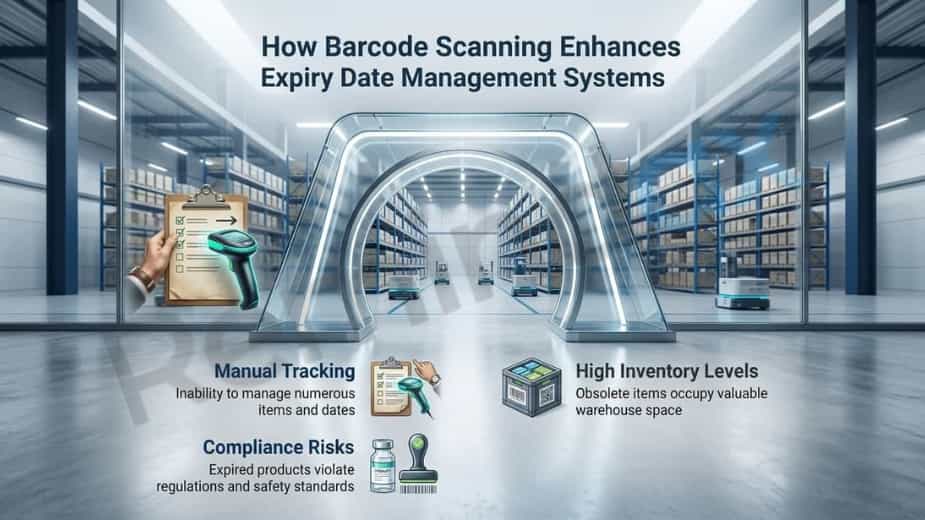
Managing expiry dates manually is one of the most error-prone and time-consuming tasks across industries, from healthcare and pharmaceuticals to food service, manufacturing, and construction. A single mistake in a spreadsheet or a missed alert can mean thousands of dollars in wasted inventory, failed compliance audits, or worse, a patient safety incident.
Barcode scanning fundamentally changes this equation. Instead of relying on human memory, manual checks, and static spreadsheets, barcode-enabled expiry date management systems automate the capture, tracking, and alerting process, creating a reliable, auditable chain from receiving to use or disposal.
This guide covers everything you need to know: how barcode scanning works for expiry date management, which barcode standards matter, how tools like Remindax help automate the entire process, and best practices for implementation across different industries.
Why Manual Expiry Date Tracking Fails at Scale
Most organizations start with spreadsheets. They’re free, familiar, and flexible. But as inventory grows, the cracks appear fast.
Studies consistently show that 94% of business spreadsheets contain at least one error. For expiry date tracking, this isn’t a minor inconvenience, it can mean expired pharmaceuticals remain in circulation, surgical supplies stay flagged as “in rotation” weeks past their use-by date, or food products sit on shelves past their safety window.
The real problem isn’t just data entry errors. It’s that spreadsheets are passive. They don’t alert you when something is about to expire. They don’t enforce rotation rules. They don’t update automatically when a product is used or moved. Someone has to open the file, check every row, and act on what they find, every single day, for every single product.
As inventory scales into the hundreds or thousands of SKUs across multiple locations, this becomes operationally impossible to sustain without errors.
The consequences are measurable. The healthcare industry alone wastes an estimated $25.7 billion annually on supply chain inefficiencies, with product expiration accounting for 8 to 10 percent of total supply spend. In food service and retail, expired inventory drives shrink, health code violations, and potential product recalls. In manufacturing and construction, expired certificates, calibration records, and materials create liability and project delays.
Barcode scanning removes the passive nature of manual tracking and replaces it with a system that captures data automatically, flags risks proactively, and creates an auditable record that manual methods simply cannot match.
The Core Role of Barcode Scanning in Expiry Date Management
At its most basic level, a barcode is a machine-readable representation of data. When applied to expiry date management, barcodes allow organizations to encode product information, including lot numbers, manufacture dates, and expiration dates, into a format that scanners can read instantly and accurately.
The workflow shift is significant. Instead of manually reading a label and typing a date into a spreadsheet, a staff member scans a barcode and the system captures all relevant data in under a second. There is no transcription error. There is no missed decimal. The date, lot number, and product identity are recorded exactly as encoded.
This creates a real-time, accurate inventory record that updates with every scan. When paired with an automated alert system, it means stakeholders are notified when items approach their expiration window, without anyone having to run a manual check.
What Barcode Scanning Captures Automatically
A single scan at receiving can capture:
• Product name and GTIN (Global Trade Item Number)
• Lot or batch number
• Manufacture date
• Expiration or use-by date
• Serial number (for serialized products)
• Quantity and unit of measure
• Storage location assignment
This data flows directly into your inventory management system, creating an immediate and permanent record without manual input.
GS1 Barcode Standards for Expiry Date Encoding
Not all barcodes are created equal. For expiry date management, the global standard is the GS1 system, which provides a consistent framework for encoding product information across industries and geographies.
GS1 Application Identifiers
GS1 uses Application Identifiers (AIs) to structure data within a barcode. The key identifier for expiration dates is AI (17), followed by the date in YYMMDD format. A product expiring on April 30, 2027, for example, would be encoded as 17270430.
Other important GS1 Application Identifiers include:
• AI (01) – GTIN, the global product identifier
• AI (10) – Lot or batch number
• AI (21) – Serial number for individual item traceability
• AI (11) – Production date
• AI (15) – Best before date
One important update: as of January 2025, GS1 standards no longer permit using ’00’ as a placeholder for the day field in expiration dates. Healthcare manufacturers and distributors must now specify the exact expiration day, improving precision and reducing ambiguity across the supply chain.
GS1-128 (Code 128)
GS1-128 is a linear barcode widely used in logistics, warehousing, and distribution. Code 128 can encode expiration dates, lot numbers, GTINs, and serial numbers in a single scannable symbol. It works well on larger packaging and is readable by standard handheld scanners, making it a practical choice for receiving and warehouse operations.
GS1 DataMatrix
GS1 DataMatrix is the standard in healthcare and pharmaceuticals. This two-dimensional barcode stores the same data as GS1-128 but in a much smaller footprint, critical for tiny packaging like medication vials, surgical instruments, and diagnostic kits. It is more resilient to physical damage and can be read from any angle, including by camera-based scanners on mobile devices.
GS1 DataMatrix fulfills medicines traceability regulations in more than 75 countries and is central to the FDA’s Drug Supply Chain Security Act (DSCSA) compliance requirements. Learn more at the official GS1 standards documentation.
QR Codes
While less common in regulated supply chains, QR codes are gaining traction in food service, retail, and consumer-facing applications. They can encode expiration dates alongside URLs, preparation instructions, and product origin information. QR codes are easy to generate, widely scannable with smartphone cameras, and useful for internal tracking in lower-regulation environments.
Remindax: Centralized Expiry Date Management Powered by Barcode Scanning
Remindax is a cloud-based expiry date and document management platform designed to automate the entire tracking and alert lifecycle. It is built specifically for organizations that need reliable, scalable expiry management without the overhead of complex ERP configurations.
Barcode Scanning Integration
Remindax supports barcode and QR code scanning directly through its mobile app and web platform. When a team member scans a product barcode during receiving or stock checks, Remindax automatically captures the expiration date, lot number, and product identity – populating the inventory record without manual data entry. This eliminates transcription errors at the source.
Automated Multi-Channel Alerts
One of Remindax’s core strengths is its tiered alert system. Users can configure expiry notifications to be sent via:
• SMS
Alerts can be customized by product category, value threshold, department, and lead time. A high-value pharmaceutical might trigger alerts at 90 days, 60 days, and 30 days before expiry. A low-value consumable might only need a 14-day warning. Remindax lets organizations calibrate this to their specific operational needs.
Centralized Dashboard and Reporting
Remindax provides a real-time dashboard that shows all tracked items, their expiry status, and upcoming expirations across locations and categories. This gives inventory managers, compliance officers, and procurement teams immediate visibility into risk – without opening a spreadsheet or running a manual audit.
Reports can be exported for compliance documentation, auditor review, or internal analysis. The audit trail generated by barcode scanning and automated logging is far more defensible in regulatory audits than manually updated spreadsheets.
Document and Certificate Tracking
Remindax extends beyond product inventory to cover document expiry management – including:
• Certificates of insurance (COIs)
• Calibration certificates for equipment
• Staff certifications and licenses
• Vendor compliance documents
• Regulatory permits and accreditations
This makes Remindax a unified platform for all expiry-related risks, not just physical inventory. For construction, manufacturing, and professional services firms, this is particularly valuable. You can learn more and start a free trial at Remindax.
FIFO vs FEFO: Choosing the Right Inventory Rotation Strategy
Barcode scanning doesn’t just capture data – it enables intelligent inventory rotation. But the right rotation strategy depends on your products and industry.
FIFO – First In, First Out
FIFO rotates inventory based on arrival date. The oldest stock is used or shipped first, regardless of individual item expiration dates. This works well for products with uniform expiry windows or non-perishable goods where date variation between batches is minimal.
FIFO is simple to implement and prevents any batch from sitting indefinitely, but it can lead to waste if a later shipment has a shorter expiry window than an earlier one.
FEFO – First Expired, First Out
FEFO prioritizes the items with the earliest expiration dates, regardless of when they were received. This is the standard in pharmaceuticals, food service, and any environment where expiry dates vary between batches.
Consider this scenario: a hospital receives two shipments of the same surgical supply. The first shipment expires in 18 months. The second, received a week later, expires in 12 months due to manufacturing date differences. FIFO would use the first shipment first – potentially leaving the 12-month items to expire unused. FEFO catches this and ensures the shorter-dated items are consumed first.
Barcode scanning makes FEFO practical at scale. When every item is scanned at receiving and tagged with its exact expiry date, the system can automatically generate pick lists sorted by expiration – enforcing FEFO without requiring staff to manually check every label.
Industry-Specific Applications of Barcode Expiry Tracking
Healthcare and Pharmaceuticals
Healthcare organizations face some of the most demanding expiry tracking requirements. Patient safety, regulatory compliance, and accreditation all depend on accurate, real-time visibility into product expiration across surgical supplies, pharmaceuticals, biologics, and sterilization materials.
The FDA’s Drug Supply Chain Security Act (DSCSA) requires full serialization and traceability for prescription drug packages – each must carry a unique barcode encoding GTIN, serial number, lot number, and expiration date. Small dispensers face a compliance deadline of November 27, 2026. For facilities not yet compliant, barcode scanning implementation is now urgent. More information is available at the FDA DSCSA compliance page.
Beyond regulatory compliance, barcode scanning at the point of care allows nurses and pharmacists to verify that the item they are about to use has not expired before administration, a critical safety check that manual systems cannot reliably provide.
Food Service and Retail
Restaurants, grocery chains, and food distributors deal with constant pressure to minimize waste while staying compliant with food safety regulations. In the food industry, FEFO is the dominant rotation strategy, with expiry and use-by dates calculated based on batch-specific shelf life and production dates.
Barcode scanning enables staff to log incoming deliveries instantly, assign storage locations, and receive automatic alerts as items approach their use-by dates. For prepared items that don’t carry manufacturer barcodes, barcode label printers can generate internal QR codes at time of preparation, capturing the prepared date and use-by window for consistent tracking.
Manufacturing and Industrial Operations
Manufacturers track expiry dates across a wide range of assets, from raw materials and chemical inputs with shelf-life limits, to safety certifications, equipment calibration records, and quality compliance documents.
Barcoding materials at intake allows the inventory system to enforce FEFO for inputs like adhesives, coatings, and reactive chemicals that degrade over time. For quality management, barcode-linked records ensure that only in-date calibration certificates and compliance documents are active, preventing the use of equipment or materials outside their certified window.
Construction and Project Management
Construction companies face a less obvious but equally important expiry tracking challenge. Key expiry-dependent assets include:
• Certificates of insurance (expired COIs can halt projects entirely)
• Safety equipment certifications (harnesses, fall protection, respiratory equipment)
• Contractor and subcontractor licenses
• Chemical and material shelf-life (sealants, adhesives, fire retardants)
• Equipment calibration and inspection records
Barcode scanning on equipment and materials creates a fully auditable trail that helps construction firms demonstrate compliance during project audits and reduces liability exposure from expired documentation.
How to Implement a Barcode Expiry Tracking System: Step by Step
Step 1 – Audit Your Current Inventory and Processes
Before selecting technology, map your current workflow. Identify what you’re tracking, how often items expire, where the pain points are, and which compliance requirements apply to your industry. This audit shapes every decision that follows.
Step 2 – Choose the Right Barcode Format
Your barcode format should align with industry standards and the data you need to capture. Healthcare and pharma organizations should default to GS1 DataMatrix. Food and distribution operations typically use GS1-128 for incoming goods. For internal labeling of prepared items or non-barcoded products, QR codes are practical and low-cost.
Step 3 – Select Your Scanning Hardware
For most operations, modern barcode scanning apps on iOS or Android smartphones provide sufficient accuracy and speed without significant hardware investment. For high-volume warehouse or manufacturing environments, dedicated handheld scanners or fixed-mount scanners at receiving stations improve throughput. For damaged or poorly printed codes, 2D imagers outperform laser scanners.
Step 4 – Implement Your Inventory Management Platform
The barcode is only as useful as the system it feeds. Choose a platform that integrates barcode scanning with automated expiry alerts, real-time inventory records, and reporting. Remindax is purpose-built for this use case and supports scanning via mobile app with multi-channel notifications and a centralized management dashboard.
Step 5 – Establish Labeling Standards for Internal Items
Products you manufacture, repackage, or prepare internally need internal barcodes. Invest in a barcode label printer and establish a consistent labeling standard that includes expiration date, lot number, and product identifier. This ensures all inventory – regardless of origin – is trackable through the same system.
Step 6 – Configure Alert Thresholds and Workflows
Set tiered expiry alerts based on product category and operational lead time. A product requiring specialized disposal procedures needs longer lead time than one that can be reordered in 48 hours. Map alerts to the right people: inventory managers, department heads, compliance officers, and procurement teams may all need different information on different timelines.
Step 7 – Train Staff and Build Scanning Habits
Technology adoption depends on habit formation. Run hands-on training sessions with real products and scanners. Reinforce the “why” – show staff how scanning saves time compared to manual spreadsheet updates and prevents the downstream problems caused by missed expirations. Start with a pilot in one department, gather feedback, and expand from there.
Overcoming Common Barcode Implementation Challenges
Legacy Products Without Barcodes
Not every product arrives with a scannable barcode. For legacy inventory, print internal labels using a barcode label printer. Assign your own SKU-based identifiers and encode the expiration date, lot number, and product category. Apply these labels during the next physical count to bring existing inventory into your system.
Damaged or Unreadable Codes
Linear barcodes are vulnerable to damage from moisture, abrasion, and poor printing. 2D barcodes like DataMatrix are significantly more resilient and can still be read when partially damaged. For environments where codes are frequently damaged, invest in 2D imager scanners and print labels at higher density for better durability.
Integration with Existing Systems
Choose an inventory management platform with open APIs and pre-built integrations for common ERP, WMS, and practice management systems. Cloud-based solutions like Remindax are designed for straightforward integration without the complexity of on-premise software deployments.
Inconsistent Supplier Labeling
Suppliers may use different barcode formats, inconsistent data encoding, or labels that don’t meet GS1 standards. Build a receiving protocol that catches non-compliant labels at intake and applies an internal label before products enter storage. This normalizes your data regardless of supplier practices.
The Role of Automated Alerts in Proactive Expiry Management
Manual spreadsheets are passive documents – they sit and wait to be checked. Automated expiry management systems are active – they push information to the right people at the right time, without anyone having to run a manual check.
Effective automated alert systems include:
- Tiered notifications – first alerts at 90 or 60 days, escalating reminders at 30 days, urgent flags at 7 days or fewer.
- Role-based routing – inventory managers see comprehensive reports, department heads see alerts for their areas, procurement teams get early warnings to adjust purchase orders.
- Value-based prioritization – high-value items trigger earlier and more frequent alerts than low-value consumables.
- Multi-channel delivery – email, SMS, WhatsApp, and Slack ensure alerts reach people even when they’re not logged into the system.
Remindax allows full customization of these alert parameters, ensuring organizations can configure the system to match their operational rhythms without generating notification fatigue from over-alerting.
AI and the Future of Expiry Date Management
Barcode scanning is the foundation – but the next generation of expiry management systems builds on it with artificial intelligence and predictive analytics.
AI-powered platforms analyze historical usage patterns to predict which items are at risk of expiring before they can be used. They can automatically suggest order quantity adjustments, recommend inventory transfers between locations, or flag items for promotional clearance to prevent waste.
Computer vision technology is advancing to the point where smartphone cameras can extract expiration dates from printed text directly – no barcode required. While this is currently less reliable than standard barcode scanning for regulated environments, it is improving rapidly and will help bridge gaps for legacy products and inconsistent supplier labeling.
IoT integration adds another layer. Smart shelves with embedded sensors can automatically detect inventory movement and report real-time stock levels, while temperature and humidity monitors paired with barcode data enable cold chain compliance verification for pharmaceuticals and perishables.
The direction is clear: expiry management is moving toward zero-touch automation – where data is captured automatically, risks are flagged proactively, and decisions are supported by predictive analytics rather than reactive manual checks.
For more on where supply chain technology is headed, the GS1 global standards blog provides ongoing industry updates.
Key Entities and Concepts in Barcode Expiry Management
Understanding the ecosystem of barcode expiry tracking means knowing the key organizations, standards, and regulations that govern it:
- GS1 – The global standards body that defines barcode formats, Application Identifiers, and data encoding rules for supply chain traceability
- FDA DSCSA – The Drug Supply Chain Security Act, which mandates serialization and traceability for pharmaceutical products in the United States
- GS1 DataMatrix – The two-dimensional barcode format required for pharmaceutical and healthcare product traceability in over 75 countries
- FEFO (First Expired, First Out) – The rotation strategy that prioritizes items with the nearest expiry date, regardless of receipt order
- FIFO (First In, First Out) – The rotation strategy that prioritizes the oldest received inventory
- Application Identifier (AI) – The GS1 data element prefix that identifies the type of data encoded in a barcode
- Lot/Batch Number – The identifier that groups products manufactured together, essential for recall traceability
- GTIN (Global Trade Item Number) – The unique product identifier used globally to distinguish products across supply chains
- Remindax – A cloud-based platform for expiry date and document management with barcode scanning, automated alerts, and centralized dashboards
Take Control of Expiry Date Management Today
Manual expiry date tracking does not scale. Spreadsheets create risk, require constant manual effort, and fail silently – often until the damage is already done. Barcode scanning combined with an automated alert platform changes the dynamic entirely: data is captured at the point of receiving, rotation rules are enforced systematically, and stakeholders are notified proactively before items expire.
Whether you manage pharmaceuticals in a hospital, perishable food in a distribution center, or compliance documents across a construction portfolio, the principles are consistent: automate data capture, enforce rotation intelligently, and alert the right people in time to act.
Remindax brings these capabilities together in one platform – barcode scanning, multi-channel alerts, centralized dashboards, and document expiry tracking – without the complexity of an enterprise ERP implementation. It is built for organizations that need expiry management to work reliably, from day one.
Start a free trial at Remindax.com and see how automated expiry management reduces waste, supports compliance, and removes the operational burden of manual tracking.