
Compliance tracking software that keeps you audit-ready every day
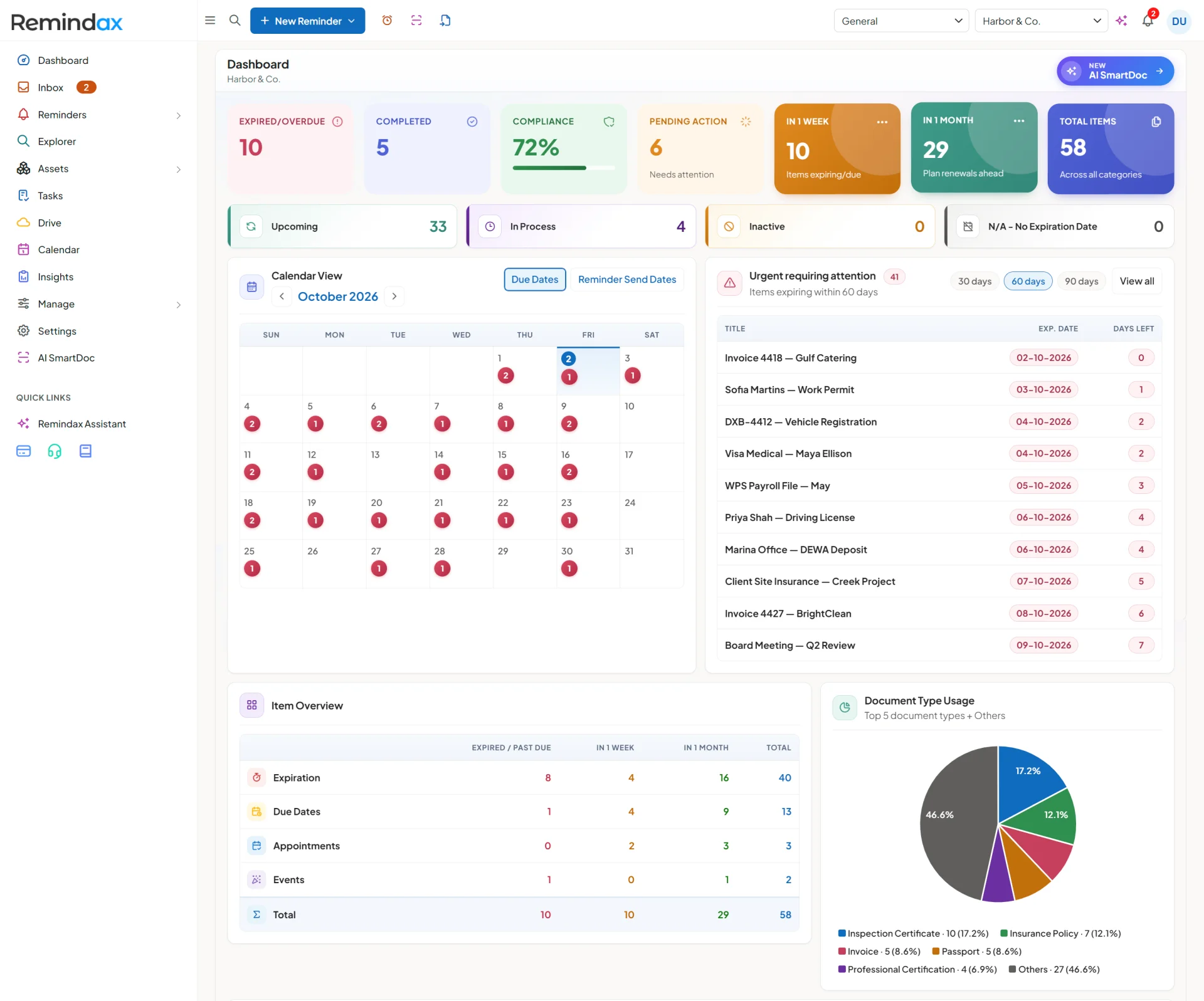
Remindax helps compliance teams track every certification, license, permit, training, and insurance renewal across the whole organization — in one place, with automated Email, SMS, and WhatsApp alerts before anything expires and audit-ready reports in one click. So you're audit-ready every single day, not just when the auditor calls.
- GDPR-ready
- Forever-free plan
- iOS & Android App
Trusted by 30,000+ teams to track every expiration date








Why compliance teams choose Remindax
Compliance teams carry the whole organization's expiry dates — certifications, licenses, permits, mandatory training, and insurance, across every department and site. One lapse anywhere becomes your finding, your fine, your audit failure.
A spreadsheet can't send a reminder, can't escalate, and is out of date the moment someone forgets to update it. Remindax watches every date, tells the right owner in advance, escalates if no one acts, and produces the evidence the instant an auditor asks.
Automated alerts with escalation
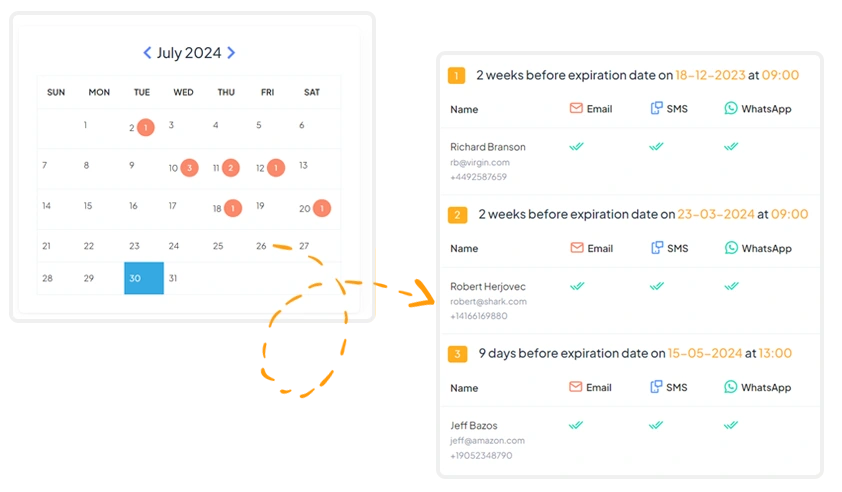
Set the cadence once and Remindax reminds each document's owner before expiry — and escalates to the compliance team if no one acts — across Email, SMS, and WhatsApp.
- • Alerts at 90/60/30/7 days
- • Per-owner reminders, not one overloaded inbox
- • Automatic escalation when a renewal is overdue
Centralized compliance register
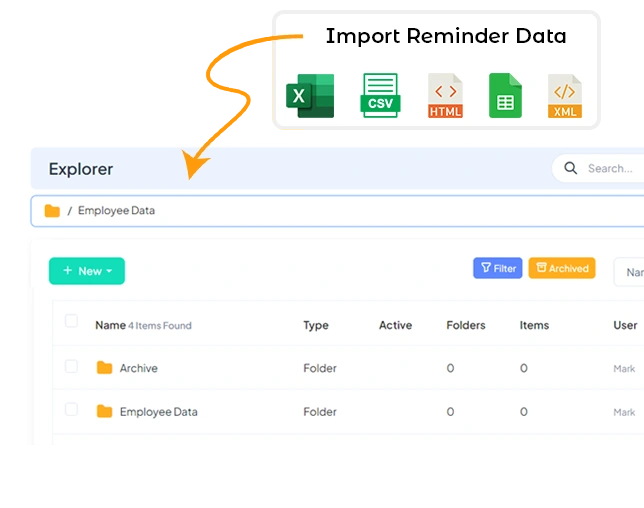
Keep every compliance document across the organization in one place — certifications, licenses, permits, training, and insurance — with a live status on each. Drill from a company-wide compliance view down to a single document.
- • Filter by department, site, document type, or owner
- • Color-coded status: compliant, expiring, expired
- • AI SmartDoc auto-reads expiry dates on upload
One-click audit-ready reporting
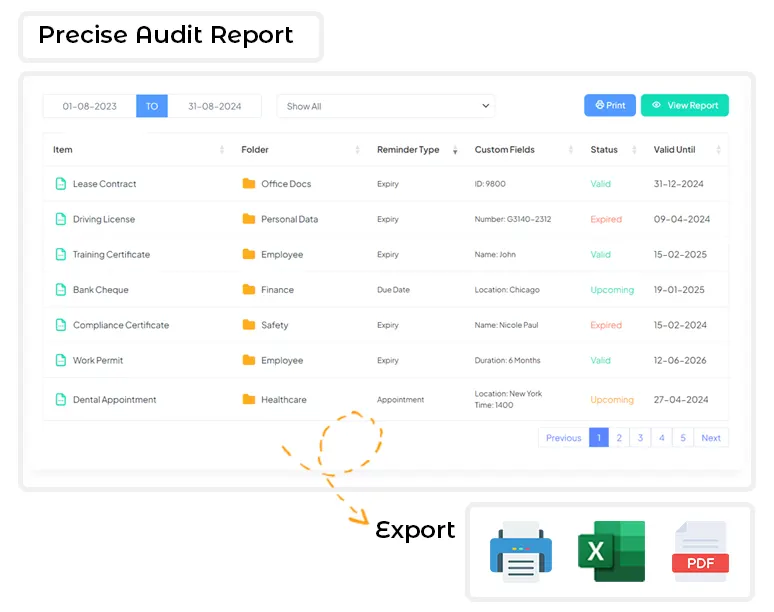
When the auditor arrives, export a complete, timestamped compliance report — every document, every renewal, every action — in under a minute, instead of scrambling for evidence.
- • Audit-ready exports (Excel & PDF)
- • Full audit trail of who renewed what, when
- • Filter by department, site, or date range
Every compliance document, one platform
Compliance spans more document types than any other function. Remindax tracks them all — explore each:
Licenses
Business, professional, and operating licenses.
Learn MoreCertifications
Employee and role certifications.
Learn MoreInsurance & COIs
Policies and vendor certificates of insurance.
Learn MorePermits
Building, environmental, and operating permits.
Learn MoreTraining
Mandatory and refresher training.
Learn MoreCredentials
I-9s, work authorization, and background checks.
Learn MoreContracts
Agreements, renewals, and notice periods.
Learn MoreWarranties
Asset warranties and maintenance schedules.
Learn MoreSome obligations don't sit neatly in one category. A cleared defense contractor's facility clearance tracking spans people, contracts, and recurring reviews at once — and a construction firm's vendor compliance file holds documents it doesn't own. A certified producer's organic certification renewal is a whole annual cycle rather than a single expiry. And a pest control or landscape crew's applicator category and CE tracking has to go a level below the license, because a single category can lapse while the license itself stays valid. A food producer's kosher and halal certification renewal goes a level below the certificate for a different reason — it names the products it covers, so a new or reformulated item needs adding before it's included. A design practice's PE and architect license tracking runs a level above the individual instead — the firm holds its own Certificate of Authorization in every state it offers services in, so licensed staff alone don't make the practice authorized. And a utility's water and wastewater operator certification tracking has to match a graded credential to each facility's classification — a plant with several certified operators can still be out of compliance if none holds the grade its classification requires. An imaging or dental practice's X-ray machine registration and radiation-safety tracking runs at two levels at once — a materials license and a designated officer over the facility, plus a registration renewal and a survey interval on every individual machine, so a lapse either idles one room or reaches every source, depending which level it happened on. And a company operating beyond the state it was formed in holds a certificate of authority in each of the others, kept alive by an agent, a report, and fees — an obligation that breaks nothing operationally when it lapses and instead surfaces the day the company needs to sue someone there. A defense contractor's CMMC certification and annual affirmation invert the usual question altogether — the level required is set by contracts it hasn't won yet, so the obligation is defined by the pipeline rather than by anything visible inside the business today. A pharmacy's permit, DEA and state registration, and pharmacist-in-charge tracking answers to two governments at once for a single act — a board licenses the store, and a federal agency separately registers the same counter to dispense controlled substances, so being current with one proves nothing about the other. A chemical manufacturer's DOT hazmat registration is triggered by an activity rather than an asset — owed because of what leaves the loading dock, not because the business owns a truck — so nothing on the premises ever signals that the certificate exists, let alone when its term ends. And a payments, remittance, or crypto business carries a pair that behaves unlike either — its FinCEN registration and state money transmitter licenses look like the same obligation at two levels and aren't: the federal filing is a disclosure that permits nothing, the state license is the permission, and ordinary commercial growth — an equity transfer, a bigger agent network — can open a federal filing deadline that no renewal notice will ever mention. And a prescription-drug wholesaler's state distributor licenses and annual FDA licensure report invert who the lapse actually stops — the warehouse keeps running, but the companies buying from it and selling to it can no longer lawfully transact, because authorized trading partners may only deal with other authorized ones. A large employer’s EEO-1 report filing inverts the usual scheduling problem — the EEOC announces each year’s collection instead of repeating a fixed date, so what gets tracked is the check itself rather than a deadline. And an Applicable Large Employer’s ACA 1095-C furnish and file deadlines hide their real exposure behind two ordinary dates — filing on time settles the paperwork, and is also what lets the IRS work out whether an employer-mandate penalty is owed, in a letter that may not arrive for years. And a pipeline operator's Operator Qualification tracking breaks the one-row-per-person shape entirely — qualification is held per individual per covered task, on requalification intervals the operator writes into its own program rather than reads off a regulator's schedule, and it extends to contractor personnel, so a worker can be current on three tasks and lapsed on a fourth while every roster still shows them as qualified. And every employer, from its first hire, carries one that never reaches a compliance calendar at all — new hire reporting, where the deadline is created by the act of hiring rather than by any date, runs from the day someone first worked for pay rather than the date on their contract, and arrives all over again for a returning employee who was away 60 days or more. And an oil-storage facility's SPCC plan review and certification makes even the signature conditional — a qualified facility may certify its own plan while a larger one needs a licensed Professional Engineer, and because eligibility turns on aggregate capacity and a rolling three-year discharge look-back, a site can move between the two in either direction without a single notice being sent. And a medical device maker's FDA establishment registration and device listing review hides two problems inside one published deadline — the listing has to be affirmed every year regardless of whether anything changed, so the companies with the most stable product lines are the ones whose own operations give them no reason to remember it, and the user fee has to be paid and processed before the registration can be completed at all, which quietly moves the real deadline days earlier than the December 31 everyone has written down. And a fundraising nonprofit's charitable solicitation registration is triggered by the act of asking rather than by any presence in a state — so the map is drawn partly by where donors happen to be, a lapse is answered with an order to stop soliciting rather than a fine that leaves the fundraising running, and each state's renewal can turn into an audited financial statement the year the organization crosses that state's threshold. And any business that pays contractors carries one whose real deadline is invisible — 1099-NEC filing, where the contractor copy and the IRS copy go out on the same January 31 date with no gap in which an error can be caught, and whether you can file correctly at all was settled months earlier by whether anyone collected a W-9 before the vendor was paid. And a remote seller's sales tax economic nexus is triggered by sales volume rather than by any office in the state — so the map is drawn by ordinary orders against roughly forty-five moving thresholds, a missed crossing is paid from margin, and the filing calendar that starts after you register is a different job. And a defense manufacturer's ITAR / DDTC registration renewal is a precondition rather than a permission — it authorizes nothing by itself, yet without its annual renewal DDTC won't process a single export-license application, and it's owed even by shops that only make USML components domestically and never export, with no grace period and a change-reporting clock measured in days. And a facility holding a highly hazardous chemical at or above a threshold quantity carries two obligations that read as identical and behave differently — PSM and RMP process safety tracking, where the PHA revalidation and the RMP resubmission both run on five years, but only EPA’s is recalculated from the most recent update its rule required, so the harder a site works at managing change the further its two five-year dates drift apart. And a law firm holding client money in trust carries one whose failure mode is unlike any of these — trust-account reconciliation tracking, where the rules commonly create two recurring acts of different weight rather than one: a routine tie-out of the firm's records to the bank statement, and a signed three-way report that also proves every individual client ledger adds up. Because both are called the reconciliation and both land in the same week, the risk is not that the work is skipped but that the easier act quietly stands in for the harder one, and the errors only the harder one can see — a disbursement charged to the wrong matter never changes the account total — sit undetected in the meantime. And a franchisor carries one that is unlike every other annual date on this page — its FDD annual update and franchise registration renewals, where the federal deadline is a date to have prepared a document rather than filed one, so meeting it produces no receipt and missing it produces no notice; the document is also revised quarterly whenever something material changes, and in the states that require registration a renewal filed before expiry still leaves the franchisor unable to sell there until an examiner declares it effective. Remindax tracks those as status and dates alongside everything else. And a finance team's unclaimed property and escheatment deadlines invert the usual pattern once more: the obligation is created not by anything the company does but by a payee who never cashed the check, and which state is owed turns on the last known address in your own books rather than on any state you chose to enter. And a bank, credit union, MSB or broker-dealer carries one with no date on it at all — BSA/AML program and independent testing tracking, where the FFIEC's own manual states there is no regulatory requirement establishing a testing frequency, so the institution sets its own interval and only learns at the examination whether it was defensible — and the interval moves in one direction only, because findings pull the next test closer while a clean report never buys more time.
And a software or services company selling to enterprise buyers carries one whose dates are set by three parties at once — its ISO 27001 surveillance audit and recertification tracking, where the certification body counts the surveillance obligation from the decision date rather than the one printed on the certificate, the accreditation system can overwrite that expiry entirely when a new edition of the standard is published, and the Statement of Applicability underneath has no expiry date at all — so the document most likely to be out of date is the one nothing will ever remind you about.
And a registered investment adviser carries the one obligation on this page that is permitted to stay inaccurate — its Form ADV annual amendment deadlines, where an interim amendment need not correct nine listed items of Part 1A even where the firm already knows those answers are wrong. The annual updating amendment, due 90 days after fiscal year-end, is the only sweep that clears them, and it is also the reference point a second deadline is measured from: whether clients are owed a brochure at 120 days turns on material changes since that amendment rather than since any date on a calendar.
And a diverse-owned supplier bidding public and corporate work carries the one credential here that never expires at all — its MBE, WBE and DBE certification dates, where a certifier may not require the firm to renew or recertify, and what recurs instead is a sworn declaration of eligibility due each year on the anniversary of the original certification. The receipts reported on it are averaged and tested against caps, so filing accurately and on time is also how a growing firm is measured out of the program — and any change in ownership, management or control starts its own 30-day clock.
And an aerospace or defense special-process supplier carries the one obligation on this page with no schedule of its own — its Nadcap accreditation and merit-based re-audit dates, where the interval before the next audit is awarded on the strength of the last one: consistent performance stretches it toward 18 or 24 months and findings pull it back to 12, with corrective actions to close on the administering body's clock. Because accreditation is granted per special process rather than per company, one supplier holds several of these clocks at once and they were never going to agree — and since prime contractors verify status in a shared database before placing orders, the cost of the one that slipped is work that stops arriving rather than a certificate that expires.
Compliance oversight from anywhere
Check what's expiring, get alerts, and review compliance status on the go with the Remindax iPhone and Android apps.


Free to download · No credit card required
Everything compliance teams need
Real-time tracking
See what's expiring at any moment — across every department and site.
Org-wide compliance dashboard
One live view of compliance status across the whole organization.
Automatic alerts & escalation
Owners get reminded, and overdue renewals escalate to the compliance team.
Multiple views
Next 15, 30, or 90 days — focus on what's due, when it's due.
Data security
Encrypted storage on AWS secure cloud, with role-based access.
Chat support
Real people, on chat — help when your team needs it.
Testimonials
What our customers say about Remindax
Saved my team hours every week!
Remindax helps us keep track of all client follow-ups automatically. It's an absolute lifesaver for our sales team, ensuring no lead slips through the cracks. Thank you @Remindax for the efficiency boost!
Michael S.
Sales Manager, @ProSales_MGR

Reduced missed renewals to zero!
Since implementing @Remindax, we've reduced missed subscription renewals to zero. The custom reminder chains are essential for our SaaS business model and provide incredible peace of mind.
Sarah K.
Operations Lead, @SK_Ops
Excellent customer support makes all the difference.
I had a technical question about an integration, and the @Remindax support team was fantastic. Quick responses and genuinely helpful in getting our system configured perfectly. Top-notch service!
Jenna F.
Accountant, @JFinancial

Powerful automation for compliance.
The automation features are exactly what our regulatory firm needed. We can set up complex, recurring tasks and trust that @Remindax manages our compliance checkpoints perfectly. Set it and forget it!
Robert M.
Compliance Officer, @Rob_Compliance
Seamless integration with our existing tools.
We love how seamlessly @Remindax integrates with our existing CRM and calendar. It pulls all of our key action items together into one centralized, manageable dashboard.
Tom W.
Product Manager, @Tom_P_M
Fantastic customization options.
The level of customization for reminder schedules is fantastic. We can set up complex recurrence patterns for unique client milestones easily thanks to @Remindax.
Linda P.
HR Specialist, @LP_HR
Boosted our team accountability.
This tool is perfect for team accountability. Everyone knows exactly who is responsible for which follow-up and when. It's fundamentally changed how our team prioritizes tasks. Great work, @Remindax!
Ben H.
Team Lead, @BH_Leadership
Frequently Asked Questions
It tracks every compliance document and deadline across your organization — certifications, licenses, permits, training, and insurance — with automated reminders before anything expires and one-click audit reports, so you're always audit-ready.
No — Remindax focuses on compliance deadline and document tracking: it watches every expiry date, reminds the right owner, and produces audit evidence. It complements GRC tools rather than replacing them.
Yes — reminders go to each document's owner and escalate to the compliance team automatically if no one acts before the deadline.
Yes — Remindax can track the renewal dates of your SOC 2, HIPAA training, and other compliance milestones and remind you before they're due. (Remindax itself is GDPR-ready and hosted on AWS secure cloud.)
In under a minute — export a complete, timestamped report of every document, renewal, and action, filtered however the auditor needs it.
Yes — a forever-free plan, no credit card required.
Why businesses trust Remindax
Trusted by 30,000+ clients to automate renewal reminders.
35%
Improved compliance on contract renewals
50% ↑
Increase in on-time task completion
4x
More reminders managed with automation
70%
Fewer missed deadlines
Stop losing track of
critical deadlines.
Join 30,000+ businesses that use Remindax to automate expiry tracking, compliance, and renewal reminders — so nothing slips through the cracks.