
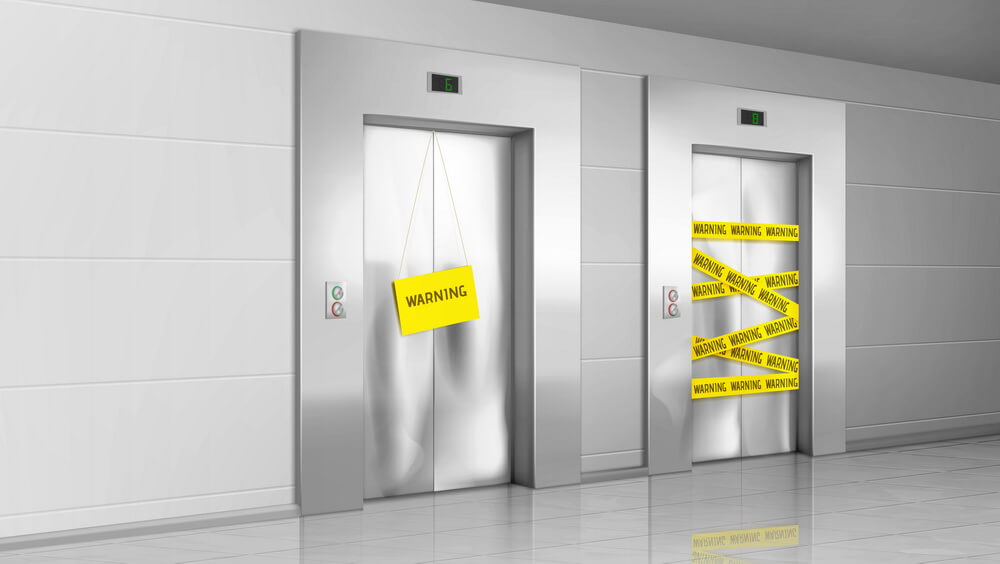
Most compliance documents live in a filing cabinet. This one lives at eye level in a steel box that several hundred people ride every day. The elevator inspection certificate is framed on the wall of the car with a date printed on it, and anyone travelling to the fourth floor has about twelve seconds with nothing else to look at. That makes it the most-read compliance document a building owns, and an expired one an unusually public thing to be caught holding.
The awkwardness is the least of it. Behind that certificate sits a record you don't hold — the routine maintenance a licensed elevator contractor performs between inspections, logged in their system rather than yours. The inspection leans on that record. And when either the certificate or the servicing slips far enough, the car can be taken out of service, which in a multi-storey building doesn't merely inconvenience people: it puts the upper floors out of reach for anyone who can't take the stairs. Here's how the dates actually work, and how to keep every certificate current.
1. What an elevator inspection certificate is
An elevator inspection certificate — called a Certificate of Operation in some jurisdictions, a Certificate of Inspection or Certificate of Compliance in others — is the document confirming that a passenger or freight elevator has been inspected and found safe to operate. It's issued by the authority having jurisdiction or by a licensed third-party inspector, it carries a date, and in most jurisdictions it's displayed inside the car itself. The technical requirements behind it almost always trace back to ASME A17.1/CSA B44, the Safety Code for Elevators and Escalators, which jurisdictions across North America adopt by reference and then amend — which is why the testing vocabulary is broadly consistent everywhere while the renewal dates on your certificates are not. Remindax records each unit's certificate and service dates and reminds you before they fall due; it doesn't inspect elevators, service them, or issue certificates.
What makes this document unusual isn't that the equipment gets inspected — plenty of building systems do. It's the posting requirement. A business license sits in a frame behind a reception desk that customers walk past without reading. An alarm test certificate lives in a folder in a plant room. The elevator certificate is presented, deliberately, to every single person who uses the equipment. The compliance status of that one asset is continuously published to your tenants, your customers, and anyone visiting the building.
1.1 What the certificate depends on
Requirements are set locally, so confirm what applies to the buildings you actually operate. Broadly, four things sit behind a current certificate:
The periodic inspection
Commonly annual in many jurisdictions, carried out by the AHJ or a licensed inspector. Passing it is what puts a current date on the certificate in the car.
Periodic safety and load testing
Deeper testing on a longer cycle than the routine inspection. Under ASME A17.1 these are the periodic Category 1 and Category 5 tests, at one-year and five-year intervals. The five-year cycle is measured in years rather than months, which is exactly what makes it easy to lose track of.
The contractor's service record
Routine servicing by a licensed elevator contractor, performed between inspections and logged by them. The inspection depends on that work having been done — and on it being evidenced.
The posted certificate
Typically displayed in the car with a visible date. Where and how it must be posted varies, so check the rule that applies to each of your buildings.
This is the structural oddity of elevator compliance, and it separates it from almost every other dated obligation a building carries. The certificate is yours — it hangs in your car, above your name on the liability. The maintenance record it depends on belongs to your elevator contractor, sits in their scheduling system, and reaches you mainly as invoices after the fact. The building holds the consequence; the contractor holds the evidence. So when servicing quietly slips a cycle — a technician reassigned, a site skipped during a busy month, a contract renegotiated between owners — nothing in the building changes and nothing tells you. You find out at the inspection, which is the worst possible moment to discover a gap, because by then the only remedy is time you don't have.
2. How often does an elevator need inspecting?
Commonly annual in many jurisdictions — the inspection that renews the date on the certificate in the car.
A deeper periodic test on a longer cycle, often measured in years rather than months.
Routine maintenance on the contract's own cadence — frequently monthly or quarterly, set by the agreement and the equipment.
Every elevator carries its own certificate and its own schedule. Two cars in one lobby are two records, not one.
Intervals are set locally — by jurisdiction, by equipment type, and by how the building is used — so read the figures above as the shape of the problem rather than the rule for your sites, and confirm each building's interval with the authority that inspects it.
The important point isn't the number, it's that two things have to stay current for one thing to stay valid. The inspection puts the date on the certificate; the servicing keeps the elevator in the condition the inspection expects to find. Track only the first and you arrive at inspection day with a car that hasn't been properly maintained. Track only the second and you have a well-serviced elevator running on an expired certificate. Neither half is optional, and neither half prompts you on its own.
2.1 The ASME test categories, and why they collide
Where jurisdictions do line up is in the vocabulary. ASME A17.1/CSA B44 defines the deeper safety checks as numbered periodic category tests, and the two you will meet on almost any passenger elevator are Category 1 and Category 5. Wisconsin's state regulator puts the intervals plainly: all Category 1 tests are performed at one-year intervals and all Category 5 tests at five-year intervals. The District of Columbia schedules the same pair as a 12-month Category 1 and a 60-month Category 5.
Every year
The annual periodic test, run on both electric and hydraulic units. In some jurisdictions the completed Category 1 form never leaves the site — it stays in the maintenance record rather than going to the inspector, which is precisely why it can lapse without anyone outside the building noticing.
Every five years
The deeper full-load safety test, witnessed by a qualified inspector. Five years is longer than most maintenance contracts run, longer than many facilities managers stay in a role, and longer than most spreadsheets survive intact — so this is the date that goes missing.
The two cycles are not alternatives. Wisconsin's regulator addresses the question directly and answers it with a flat yes: Category 1 tests are still required in the same year a Category 5 falls due, with no exceptions in years where both land together. Every fifth year, in other words, is a double year — and it arrives four years after the last time anyone thought to set a reminder.
On top of the categories, individual jurisdictions add cycles of their own that follow no shared pattern. Michigan requires hydraulic cylinders to be tested at intervals of not more than 36 months, a three-year clock sitting between the two ASME ones. Pennsylvania sets a far shorter statutory inspection frequency than the familiar annual figure — passenger elevators and escalators at least once every three months, freight elevators at least once every six. And the certificate's own validity can run on yet another clock: in the District of Columbia the certificate is valid for two years while the inspections behind it are annual. The lesson isn't the individual numbers, which will change; it's that “annual” is a starting assumption rather than a rule, and every building deserves its own confirmed dates.
3. Why tracking elevator compliance dates matters
Four things make an elevator certificate harder to hold on to than the length of its interval suggests.
The lapse is on display
Nearly every other compliance document fails privately, and you get to fix it before anyone knows. This one fails in front of tenants, customers, and visitors, who read the date without being asked to look.
An out-of-service car is an access failure
When a car stops, the upper floors stop being reachable for anyone who can't manage stairs. That isn't downtime spread evenly — it's part of the building closing to part of the people in it.
The evidence sits with someone else
The service record the inspection relies on lives in your contractor's system, not yours, so a slipped cycle is invisible from inside the building until an inspector asks for it.
Every car is its own record
The multiplication doesn't start at the second building. A single tower with six cars already holds six certificates and six service schedules, all capable of drifting apart from each other.
Read those together and the pattern is specific to this document: elevator compliance is one of the few obligations where the failure, the consequence, and the audience all arrive at the same moment. That's why the dates belong alongside the other regulated dates a building carries rather than scattered across contractors' reminder emails — the practical case for keeping them in compliance tracking software instead of one folder per vendor.
4. Who needs to track elevator dates
The same certificate means something different depending on who's holding the calendar. Five roles carry these dates most often:

Facilities managers
The person who books the inspector, chases the contractor, and physically hangs the renewed certificate in the car — first to hear when a car stops, last to be told when servicing slipped.
Learn More
Property managers
Certificates across a portfolio where each building was fitted at a different time by a different contractor, and every one of them renews on its own calendar.
Learn More
Health & safety leads
Elevators sit inside the building's wider safety program, next to the other equipment carrying statutory inspection dates that someone has to be accountable for.
Learn More
Hotel & multi-site operations
Hotels, retail, and offices running several cars per site — where guests read the certificate on the way to their floor and a stopped car is felt within the hour.
Learn More
Building owners
The name behind the posted certificate. A car out of service becomes a tenant conversation, a lease-obligation question, and sometimes an insurance one — usually in that order.
What these roles share isn't the equipment. It's the gap between who is accountable for the certificate and who performs the work that keeps it valid. In almost every case those are two different organizations — and the building is the only party with any interest in seeing both schedules at the same time.
5. What happens when an elevator certificate expires
An expired elevator certificate fails differently from most compliance documents, because it fails in front of an audience. There's no quiet interval in which the problem stays internal and gets solved before anyone notices. The date is printed and posted, the car keeps running, and every person riding it can see that the paperwork behind the machine they're standing in has run out. Tenants notice. Prospective tenants being shown the building notice. And an inspector, when they arrive, is reading a document you have already been displaying publicly for weeks.
Then comes the practical damage. Depending on the jurisdiction, an elevator operating on an expired certificate or without its required maintenance can be ordered out of service — and that's where the real cost lands. A stopped car in a multi-storey building isn't an inconvenience shared equally. It falls hardest on the people who can't use the stairs, which is precisely the population elevators exist to serve. Upper-floor tenants lose access to premises they pay for. Deliveries stop. In a hotel, guests get moved. In a residential building, some residents simply can't get home.
The way back isn't symmetrical with the way out. Restoring service generally means booking an inspection into someone else's calendar and closing any maintenance gaps first — and because the inspection depends on the service record, a cadence that slipped can turn a routine renewal into a failed inspection followed by remedial work and a re-inspection. Every one of those steps is scheduled with a third party, and the building controls the pace of none of them. That's the asymmetry worth planning around: the lapse happens on a date you could have seen coming months in advance, and the recovery happens on a timetable you don't set.
None of this requires negligence to happen. It usually starts with something administrative — a service contract changing hands, a building acquired mid-cycle with its dates undocumented, or a certificate that renewed on a slightly different date than the one everyone remembered. The elevators keep running throughout, which is exactly why nothing prompts anyone to check. It's the same failure mode as every other premises-level document that renews quietly in the background, from a business license behind the front desk to the equipment cover on the plant that keeps the building warm.
6. How Remindax tracks the dates
Remindax handles the part of this that's a dates problem: what each elevator's certificate expiry is, when its next inspection and next service fall, and telling the right people before any of them arrive.
Every car's dates in one record
Certificate expiry, next inspection, periodic testing, and service cadence held per unit and per building — so the status of a portfolio is one view rather than a round of calls to each contractor.
Reminders on the certificate and the service
Staged alerts before each inspection falls due and before each scheduled service, by Email, SMS, and WhatsApp, routed to facilities and to whoever manages the property.
Multi-building, multi-unit view
Several elevators across several sites, each on its own calendar — organized by location, so a tower with six cars reads as six records rather than one blurred entry.
Records you can produce
The certificate and its service history exportable together — the evidence an inspector, an insurer, or an incoming owner asks to see, kept where the dates already live.
Elevator dates rarely arrive on their own. Where the same buildings also carry permits and approvals renewing on their own cycles, the wider picture is set out on the permit tracking software page.
Remindax tracks the dates and reminds you. It doesn't inspect elevators, perform or schedule maintenance, issue certificates, or act as an elevator service provider. Your licensed inspector and your elevator contractor do that work — Remindax makes sure neither of their deadlines passes without you knowing it was coming.
7. Why spreadsheets fail for elevator compliance tracking
A spreadsheet can hold elevator dates. What it can't reliably do is hold both sets, and that's the specific failure. The certificate expiry gets typed in, because it's printed on a document somebody was handed. The service cadence usually doesn't, because nobody was handed anything — servicing happens when the contractor turns up, and the only trace is an invoice that arrives weeks later and goes to a different department. So the sheet ends up tracking the half of the problem that announces itself and missing the half that stays silent.
It also can't tell you anything until someone opens it, which is the wrong shape for a deadline that's on public display. A row that quietly turned red in March is worth nothing in June. And a portfolio makes this worse rather than better: as buildings are added, cars are modernized, and service contracts change hands, the sheet drifts away from the reality in the lobby without any single edit ever looking wrong.
Starting from a spreadsheet today? Begin with our free elevator, boiler & pressure-vessel inspection tracker — track each car's certificate expiry and inspection due date alongside boilers and vessels, then import into Remindax when you're ready to automate Email, SMS, and WhatsApp reminders. Date and status focused — does not inspect equipment or issue certificates.
- ✗Holds the certificate date but rarely the service cadence behind it
- ✗No prompt before an inspection or a scheduled service falls due
- ✗Stays silent when a contractor's visit is skipped or pushed back
- ✗Goes stale as buildings are added and cars are modernized
- ✗Consulted only after somebody has already noticed the posted date
- ✓Certificate expiry and service dates held together, per unit
- ✓Staged alerts before each inspection and each service visit
- ✓Every car in every building on its own schedule, visible at once
- ✓The certificate document attached to the dates it carries
- ✓Reminders by Email, SMS, and WhatsApp, with exportable records
8. Key takeaways
- ✓The certificate confirms a car is safe to operate and is typically posted inside the car itself — the most publicly readable compliance document a building holds.
- ✓Its validity rests on work you don't perform and a record you don't hold: the routine servicing a licensed contractor logs in their own system between inspections.
- ✓Intervals are set locally — commonly annual in many jurisdictions, with deeper safety or load testing on a longer cycle — so confirm what applies to each building.
- ✓A lapse can put the car out of service, and a stopped elevator makes upper floors unreachable for anyone who can't take the stairs.
- ✓Every car is its own record, so one tower with several elevators already carries several certificates and several service schedules that can drift apart.
Never let a certificate expire on the wall
Hold every elevator's certificate expiry, inspection date, and service cadence in one place, per building — with staged reminders before each one falls due, so no car goes out of service and no date runs out in public.
GDPR-ready · AWS secure cloud · Encrypted storage · Setup in under 5 minutes
9. Frequently Asked Questions
Commonly annually in many jurisdictions, with the certificate renewed on inspection, plus deeper safety or load testing on a longer cycle. Exact intervals are set locally, so confirm what applies to each building with the authority that inspects it.
Typically inside the elevator car itself, which is why an expired date is visible to tenants, visitors, and inspectors rather than staying an internal problem. Posting rules vary by jurisdiction.
Depending on the jurisdiction, the elevator can be ordered out of service until it has been inspected - and while it is stopped, upper floors become unreachable for anyone who cannot use the stairs.
Yes - routine servicing by a licensed contractor keeps the unit in inspectable condition, and gaps in that record can contribute to a failed inspection rather than a routine renewal. That record usually sits in the contractor's system rather than the building's, which is why a slipped service cycle is easy to miss until an inspector asks for evidence.
Because the disruption is not shared evenly. A stopped car makes upper floors unreachable for anyone who cannot manage stairs, which raises accessibility concerns alongside the operational cost.
No - Remindax tracks the certificate, inspection, and service dates and reminds you. Inspection and servicing are performed by licensed inspectors and elevator contractors.
Yes - each car's certificate expiry and service schedule, per building, in one place, each with its own reminders.
Yes - a forever-free plan, no credit card required.
Not Ready for Software? Start with a Free Spreadsheet
Download the matching Excel template, populate it with your data, and switch to Remindax when you outgrow it.

11. Sources & references
This page summarizes how elevator inspection and certificate cycles generally work, and isn't legal, engineering or compliance advice. Elevators are regulated locally: ASME A17.1/CSA B44 supplies the technical baseline, but inspection frequency, certificate validity, posting rules and testing requirements are set and enforced by your state or municipal elevator authority, which may adopt a different edition of the code or amend it. The examples below are cited to show how widely the intervals vary, not as the rule for your buildings — confirm each building's dates with the authority that inspects it.
- •ASME — A17.1/CSA B44, Safety Code for Elevators and Escalators — the consensus code behind most North American elevator regulation, covering design, installation, operation, inspection, testing, maintenance and alteration. Harmonized with CSA B44 and adopted by reference by jurisdictions across the US and Canada. The code itself is a purchased standard rather than a free publication.
- •Wisconsin DSPS — Category 1 and 5 Testing FAQs (PDF) — a state regulator stating the intervals directly: Category 1 tests at one-year intervals, Category 5 at five-year intervals, and confirmation that Category 1 is still required in a year when a Category 5 also falls due. Also the source for Category 1 test forms being retained in the maintenance record rather than submitted to the inspector.
- •DC Department of Buildings — Inspections and Certificates for Elevators and Other Conveyances — a jurisdiction publishing its full schedule, including a 12-month periodic inspection, a 12-month Category 1, a 60-month Category 5, and a certificate that must be conspicuously displayed in the car unless exempted.
- •34 Pa. Code § 7.15 — Inspection — the clearest illustration that “annual” is not universal: Pennsylvania requires passenger elevators and escalators to be inspected at least once every three months, and freight elevators at least once every six, with certificates posted in the cars.
- •Mich. Admin. Code R. 408.7060 — Three-year inspection and test requirements — an example of a jurisdiction-specific cycle sitting between the ASME categories, requiring hydraulic cylinders to be tested at intervals of not more than 36 months, with records maintained on site.
- •TSASK — Elevator Periodic Category Tests and Inspection Frequency (PDF) — a regulator's bulletin on the same one-year and five-year category intervals, the owner's duty to coordinate test scheduling with the maintenance contractor, and the consequence of a late test: equipment sealed out of service.