
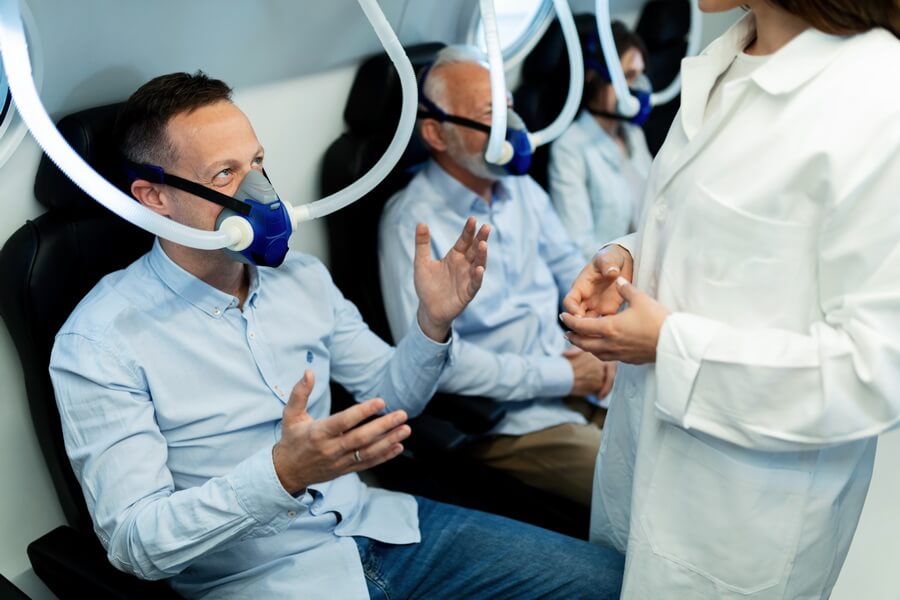
A respirator fit test looks like a simple annual checkbox until you realize it only counts when two other things are true at the same time.
Under OSHA, an employee can't be fit-tested — or wear a respirator at all — without a current medical evaluation clearing them to do so. And the fit test itself is tied to a specific respirator: the make, model, and size they were tested on. Swap them to a different respirator, or let their medical clearance lapse, and the fit test on file may no longer be valid, even if it's less than a year old. So keeping a worker cleared to wear a respirator means keeping three things in sync per person — a current medical clearance, an annual fit test, and the right respirator — plus any medical surveillance the hazard requires, like periodic audiograms. Across a crew, that's a lot of interlocking dates, and a lapse in any one can pull someone off a task they're needed for. Here's how respirator compliance works, and how to keep every piece current.
Remindax tracks the dates and status — never the health details.
1. What does OSHA respirator protection require?
Where employees must use respirators, OSHA's respiratory protection standard requires a program built on a few per-employee elements: a medical evaluation clearing the person to wear a respirator, a fit test before use and at least annually, and use of the specific respirator they were fit-tested on. Certain hazards add medical surveillance — audiograms, exposure or biological monitoring — on their own schedules. Remindax helps you track the status and dates of each of these per employee and reminds you before each; it doesn't perform fit tests or medical evaluations, or store health records.
This is what sets respirator compliance apart from the rest of the safety training calendar. Most safety credentials behave simply: a worker completes confined space entry training or a fall protection course, a card is issued, and it expires on a date printed on the card. Respirator protection doesn't work that way. The fit test has an expiry, but its validity is conditional — it depends on something else staying current, and on the worker still using the equipment it was performed with. A date that looks fine on paper can already be worthless.
1.1 The three parts that must align
Asking "is this worker cleared to wear a respirator?" is really asking three questions at once, and all three have to answer yes on the same day:
- →Medical clearance — required before fit testing or use, and renewed on the schedule your program and occupational-health provider set. Without it, nothing downstream is valid.
- →Fit test — performed before first use and at least annually thereafter, per employee. It's the date most programs track, and the only one many track.
- →Respirator make, model, and size — the fit test is specific to the unit it was performed on. A change in equipment can require re-testing before that worker uses the new respirator.
- →Plus surveillance — audiograms for hearing conservation, exposure or biological monitoring for certain hazards, each running on its own cadence independent of the fit test.
Requirements under the OSHA respiratory protection standard, including medical evaluation and fit-testing intervals, are set by regulation and can change — confirm the current rule for your workplace with OSHA and your occupational-health provider. This is general guidance, not medical or legal advice.
The mental model that fails is "we have the fit test on file." The paperwork exists, the date is inside twelve months, and the file looks complete — but a fit test isn't a certificate that stands on its own. It's the record of a test performed on one person, with one respirator, while a medical clearance was current. Change any of those inputs and the record stops describing the present. Programs that track the fit test alone end up with a tidy folder and workers who aren't actually cleared.
2. How often is a respirator fit test required?
Before first use and at least once every 12 months for each employee who uses a tight-fitting respirator.
Required first — the fit test isn't valid without a current medical evaluation clearing the employee to wear a respirator.
Valid for the respirator that was tested — a change in make, model, or size can require a new test.
Audiograms and exposure or biological monitoring run on their own schedules where the hazard requires them.
The annual date is only half the story — a fit test is valid only with a current medical clearance and for the actual respirator in use, so all three have to line up per employee. That's why "when is the fit test due?" is the wrong question to build a program around. The right one is "for each worker, are the clearance, the test, and the equipment all in agreement right now?" — and it has to be answerable on any given day, not just at the annual push.
This is the trap that makes respirator compliance different from every other annual safety date. A fit test dated four months ago is unambiguously inside its twelve months — and it can still be worthless, because the medical clearance behind it expired last month, or because the crew moved to a different respirator in the meantime. Nothing about the fit test record changes when that happens. It doesn't get flagged, re-dated, or moved. It simply stops meaning what it appears to mean, silently, while sitting in a file that looks complete.
3. Why tracking respirator compliance matters
Four features of the requirement combine to make it unusually easy to get wrong across a workforce:
The fit test depends on the medical clearance
If the medical evaluation has lapsed, the fit test isn't valid — the clearance date has to be tracked alongside the test.
A respirator change can void the test
Because the fit test is model-specific, switching respirators may require re-testing before the worker can use the new one.
A lapse pulls the worker off the task
Without a valid fit test and clearance, an employee can't wear a respirator — removing them from work that requires one.
Per-employee, plus surveillance, across a crew
Every worker has their own clearance and fit-test dates, plus any surveillance, so the calendar multiplies fast.
The first point deserves particular attention, because it's a dependency rather than a deadline, and dependencies are what calendars handle worst. A calendar is good at telling you a date has arrived. It has no way of telling you that a date you already have has quietly stopped counting. That's exactly the failure mode here: the clearance expires on its own schedule, invisibly, and the consequence lands on a different record entirely — one nobody has any reason to re-examine, because its own date is still comfortably in the future.
The good news is that none of this requires holding sensitive information to manage. What a program needs to know is when each piece is due and whether it's current — the clearance status, the fit-test date, which respirator it covers, and any surveillance due date. Nothing about what a medical evaluation found, nothing about a worker's health. The tracking that keeps the program defensible sits entirely on the safe side of that line, and it should stay there by design rather than by good intentions.
4. Who needs to track respirator fit tests and clearances
Wherever employees wear respirators, someone owns the job of keeping each worker's three parts aligned. These are the roles that carry it:

Safety / EHS coordinators
Every employee's clearance, fit test, and surveillance dates in one view — so nobody is scheduled for respirator work on a lapsed record.
Learn More
Construction & industrial employers
Crews working in silica, dust, and fume hazards — where a single lapsed clearance can leave a task without anyone qualified to perform it.
Learn More
Manufacturing & labs
Workers exposed to dusts, fumes, or chemicals — often with exposure monitoring running on its own schedule beside the fit test.

Healthcare employers
Staff requiring respirators for certain exposures — tracked as dates and status, with the health records staying in occupational health.
Learn More
Remediation / HAZWOPER teams
Respirator use alongside hazmat training and refreshers — two clocks per worker that have to stay current together.
Learn More
Workforce compliance teams
Respirator dates sitting beside every other qualification a worker holds — one calendar per person, not a separate register per requirement.
Learn MoreWhat these roles share is a coordination problem more than a paperwork one. The fit test is usually booked by safety, the medical evaluation runs through an occupational-health provider, and the decision to change respirator models can come from purchasing or from a supply shortage nobody flagged as a compliance event. Three functions, three sets of records, and one worker whose eligibility depends on all of them agreeing.
5. What happens when respirator compliance lapses
Respirator compliance fails in a way that's easy to miss because the fit test can look current while the thing it depends on has quietly expired. An employee's medical clearance lapses, and the annual fit test on file — still within its year — is no longer valid, because a person has to be medically cleared to wear a respirator in the first place. Or the crew switches to a different respirator model and everyone's model-specific fit tests need redoing before the new units can be used.
When any of these gaps opens, the practical effect is immediate: the worker can't wear a respirator, so they can't do the task that requires one, and an OSHA inspection that finds an expired clearance or an out-of-date fit test can cite the employer. The tracking difficulty is that these pieces move independently — a clearance on one clock, a fit test on another, a respirator change out of nowhere — and each employee has their own set. Tracking all of it per person, as dates and status, is what keeps workers cleared and the program defensible — without holding any of their health information.
Most compliance gaps are at least predictable — you know the date, you can see it coming, and missing it is a failure of attention. A respirator change isn't like that. A supplier discontinues a model, procurement substitutes a comparable unit, and the equipment arrives on site as an operational decision rather than a compliance one. Nobody involved is thinking about fit tests. But every worker who used the old respirator may now need re-testing, and the affected records are the ones that look most reassuring — recently dated, filed, and complete. It's the only lapse in the program that can arrive by delivery truck.
6. How Remindax keeps every worker respirator-ready
Remindax is built for exactly this shape of requirement — several interlocking per-person clocks where the sensitive part has to stay out of the tracking entirely. Four pieces work together:
Every employee's dates in one dashboard
Medical clearance, annual fit test (and the respirator model it covers), and any surveillance due date — status and dates, not health records.
Reminders on every clock
Staged alerts before each fit test, clearance renewal, and surveillance date, by Email, SMS, and WhatsApp — to safety and to the employee.
Keeps the three parts in sync
See whether clearance, fit test, and respirator model all line up per person — so a current-looking test with a lapsed clearance behind it doesn't pass unnoticed.
Privacy by design
Track the fact and date of clearance and testing; the medical records stay in the appropriate system, not in Remindax.
Remindax tracks the fit test, clearance, and surveillance dates and status — it doesn't perform fit tests, conduct medical evaluations, or store health data. It isn't an occupational-health system, an EHS platform, a fit-testing service, or a medical record of any kind. Those belong to your testing provider and your occupational-health partner. What Remindax does is make sure no worker's clearance, test, or surveillance date passes unnoticed. For the team that owns these clocks day to day, see health & safety compliance tracking, and for whoever has to evidence the program across the workforce, compliance tracking software.
7. Why spreadsheets fail for respirator compliance tracking
Respirator compliance is several interlocking clocks per employee, and a spreadsheet tends to track only the one everyone remembers — the annual fit test — while missing the medical clearance it depends on and the respirator model it's tied to. It won't warn you that a clearance lapsed and quietly invalidated a current fit test, won't flag that a respirator change requires re-testing, and won't hold each worker's surveillance dates.
There's a second problem specific to this requirement. A spreadsheet invites recording sensitive health detail it was never meant to hold — a note explaining why a clearance was delayed, a comment about a restriction, an attachment somebody thought would be useful. Once that detail is in a shared workbook it's in email attachments and desktop copies too, and it's no longer possible to say the program keeps dates only. The discipline this requirement deserves is the narrowest possible record: a due date, a status, and the respirator model the test covers. An automated system enforces that shape by design, tracks the status and dates of each part per employee, and reminds the right people before any lapse — so workers stay cleared, the program stays defensible, and the sensitive part never leaves the systems built for it.
- ✗Tracks the fit test alone and misses the clearance it depends on
- ✗Can't show that a lapsed clearance invalidated a current fit test
- ✗No record of which respirator each test covers, so equipment changes go unflagged
- ✗Surveillance dates end up in a different file, or nowhere at all
- ✗Tempts people to record health detail that shouldn't be there
- ✓Clearance, fit test, and surveillance each tracked per employee
- ✓The three parts visible together, so a broken dependency is obvious
- ✓The respirator model recorded against the test that covers it
- ✓Staged reminders ahead of every date, to safety and the employee
- ✓Dates and status only — health details stay out by design
8. Key takeaways
- ✓OSHA respirator protection requires a medical clearance, a fit test before use and at least annually, and use of the fit-tested respirator.
- ✓The annual fit test is valid only with a current medical clearance and for the specific respirator model.
- ✓A lapsed clearance or a respirator change can invalidate an otherwise-current fit test.
- ✓Without valid clearance and fit testing, a worker can't wear a respirator — removing them from tasks that require one.
- ✓Tracking each employee's clearance, fit test, and surveillance dates — as status and dates only — keeps the program compliant and private.
Never let a worker's respirator clearance lapse
Track every fit test, clearance, and surveillance date — automatically. Whether it's one crew or a workforce of interlocking per-person clocks, Remindax holds every due date in one place and reminds the right people before any of them passes. Dates and status only — health records stay where they belong.
GDPR-ready · AWS secure cloud · Encrypted storage · Setup in under 5 minutes
9. Frequently Asked Questions
Before first use and at least once every 12 months per employee, and it's valid only with a current medical clearance and for the specific respirator tested.
OSHA requires an employee to be medically cleared to wear a respirator before they can be fit-tested or use one, so a lapsed clearance can invalidate an otherwise-current fit test.
Often yes - a fit test is specific to the make, model, and size, so switching respirators can require re-testing before the new one is used.
Periodic health monitoring some hazards require - such as audiograms for hearing conservation or exposure monitoring - each on its own schedule.
The employee can't validly wear a respirator until it's resolved, removing them from tasks that require one, and a lapse can lead to an OSHA citation.
No - Remindax tracks the fit test, clearance, and surveillance dates and status only. Testing, evaluations, and health records stay with the appropriate providers and systems.
Yes - each employee's clearance, fit test, respirator model, and surveillance dates in one place, each with its own reminders - no health details needed.
Yes - a forever-free plan, no credit card required.
This page involves employee health information. Remindax tracks status and dates only — never medical evaluation contents, results, or health details — and is not an occupational-health system, an EHS platform, a fit-testing service, or a medical record. Remindax makes no HIPAA claim. Follow current OSHA requirements and your occupational-health provider's guidance; this is general information, not medical or legal advice.