
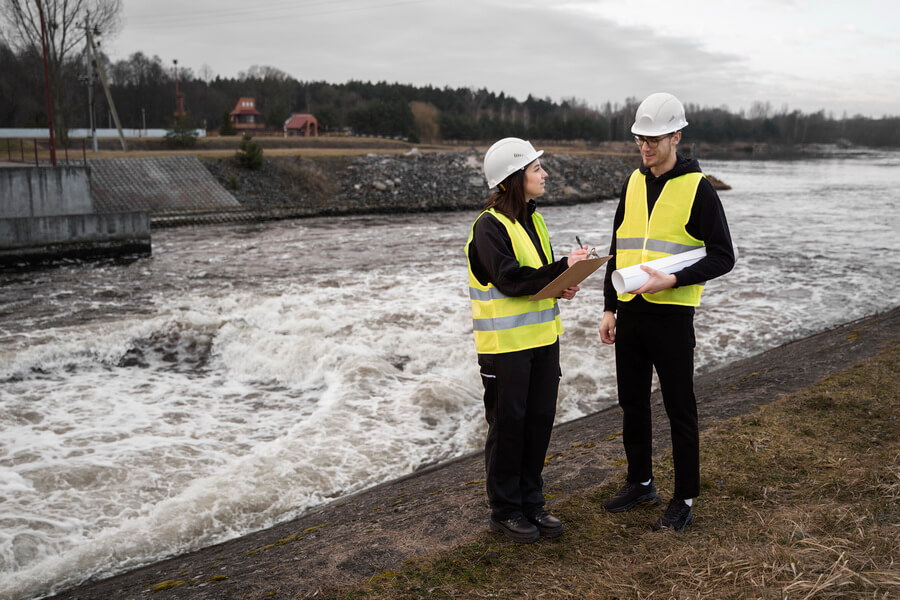
Most compliance deadlines sit on a calendar. Stormwater has one that sits on the weather.
A construction site under a stormwater permit has to be inspected on a routine cadence — often weekly — but it also has to be inspected within a set window after a qualifying rain event, which means the deadline is set by a storm nobody scheduled. That single feature makes stormwater compliance uniquely easy to miss: the routine inspections you can plan, but the post-storm one lands unannounced, on a busy site, right when everyone's dealing with the mess the rain made. Around those inspections sit the rest of the obligations — the SWPPP, a living plan of your erosion and sediment controls that has to be updated as the site changes; the permit coverage itself, active from your Notice of Intent until you file a Notice of Termination; and often an annual report. Stormwater violations carry serious penalties, and inspectors know exactly which deadline gets missed. Here's how stormwater permits work, and how to keep every inspection and date accounted for. (Remindax reminds on the dates and cadences you set — it isn't a weather service.)
1. What is a construction stormwater permit?
Construction that disturbs land generally needs coverage under an NPDES stormwater permit — for most sites a Construction General Permit, obtained by filing a Notice of Intent and ended by a Notice of Termination. The permit requires a Stormwater Pollution Prevention Plan (SWPPP) describing the site's erosion and sediment controls, routine and rain-triggered inspections, recordkeeping, and often annual reporting. Remindax helps you track the inspection cadence, SWPPP-review, permit, and report dates and reminds you; it doesn't author SWPPPs, perform inspections, monitor weather, or file with regulators.
What makes this obligation awkward to carry isn't the number of dates — plenty of compliance work involves more. It's that they aren't the same kind of date. One is a cadence that repeats until the job ends. One is a span with a start and a close-out and nothing in between. One is a plan that goes stale without anybody touching it. And one is an interrupt that arrives without warning and starts counting immediately. A single register can hold all four, but a single habit can't, which is why stormwater is usually the obligation a project manages well right up until the week it doesn't.
1.1 The obligations
- →Permit coverage — active from the Notice of Intent until a Notice of Termination is filed, which typically follows final stabilization of the site.
- →Routine inspections — on a set cadence, commonly weekly, for as long as the site is disturbed and coverage is in force.
- →Rain-triggered inspections — within a set window after a qualifying storm, on top of the routine cadence rather than instead of it.
- →The SWPPP — a living plan of the site's controls, updated as conditions, phases, and controls change on the ground.
- →Annual report — where the permit requires one, on its own deadline independent of everything above.
Exactly what applies — the inspection cadence, what counts as a qualifying rain event, how long the post-storm window runs, and whether a report is required — is set by the EPA or state permit that covers your site. Confirm the specifics against your own permit rather than assuming a single national rule. What holds everywhere is the shape: a cadence, an interrupt, a plan, and a span.
An air, water, or waste permit at a fixed facility is an authorization with a term. It was granted, it runs for a period, and the real work is getting the renewal application in months before it expires so the permit carries on. The date that governs is one that appears nowhere on the permit itself.
Construction stormwater coverage has no renewal window of that kind, because it isn't sized to a term — it's sized to a job. It begins when you file the Notice of Intent and it continues until you end it, which means the risk isn't forgetting to renew. It's the opposite: coverage quietly staying open on a site that finished months ago, still carrying obligations nobody is performing any more, because the Notice of Termination was never filed. One is a document you keep alive. The other is a span you have to remember to close.
It's also worth being precise about what "triggered" means here, because plenty of compliance obligations have triggers and most of them are nothing like this one. A building permit's inspection milestones are triggered by the state of the work — you decide when the footing gets poured, so you effectively decide when that inspection becomes due, and the sequence moves at the pace you set. Retraining requirements are triggered by change: a new procedure, a different machine, a rotated role. Those triggers are all internal. You cause them, you know the instant they fire, and nothing starts counting until you're ready.
A qualifying storm is none of those things. Nobody on the project causes it, nobody can foresee it more than a few days out, and the moment it happens a fixed window opens and begins to close — whether or not anyone on site has noticed. It is the only obligation of its kind most construction teams carry: a deadline that is simultaneously involuntary, unpredictable, and immediate.
2. How often is a construction site inspected for stormwater?
On a set cadence, often weekly, for as long as the site is disturbed.
Within a set window after a qualifying rain event, in addition to the routine cadence.
Updated as controls and site conditions change, not on a fixed annual date.
Coverage from NOI to NOT, plus any annual report the permit requires.
The rain-triggered inspection is the distinctive one — its deadline is set by a storm, not the calendar, so it can't be scheduled ahead and is the one most often missed.
Two things about that are worth spelling out, because they're what turn an unusual rule into a genuinely difficult one to keep. The first is that the trigger itself is a judgment call made in the field: not every shower counts, and somebody has to decide, at the time, whether what fell over the site met the permit's threshold. That decision is easy to defer and easy to get wrong in hindsight, and it is being made by people whose actual job that morning is drainage and mud. The second is that the window is short by design — the whole point is to see the site while the evidence of what the rain did is still visible. Which means the inspection has to happen during precisely the period when the crew is most occupied by the same weather that triggered it.
Other living plans go out of date when a decision is made. A HACCP plan needs revisiting when you change a recipe, a process, or a supplier — somebody chose to do that, and there's a moment you can point to. The SWPPP is different in kind, because what it describes is physical. It says where the silt fence runs, where inlet protection sits, which slopes are stabilized and which are open. And a construction site rearranges that reality continuously — a stockpile moves, a slope is cut, a control is pulled to let a machine through and never reinstated.
So the plan drifts out of alignment with the site through ordinary work, without any decision being taken and without anyone doing anything wrong. Nobody changed the SWPPP; the ground changed underneath it. That's why an out-of-date SWPPP is such a reliable inspection finding: the inspector isn't comparing your plan to last year's plan, they're comparing it to what's in front of them, and the site always moves faster than the document.
3. Why tracking stormwater dates matters
Four things make this harder than a normal inspection schedule, and they don't simply add up — each one makes the others easier to miss.
The storm-triggered inspection can't be pre-scheduled
Its deadline depends on a rain event, so it needs a standing reminder or checklist rather than a fixed calendar slot.
Routine inspections are frequent
A weekly (or similar) cadence across the life of a project is a lot of recurring dates to keep — and each one has to be documented, not just done.
The SWPPP must stay current
As the site changes, the plan has to be updated; an out-of-date SWPPP is a finding at inspection even when the controls themselves are sound.
Coverage and reporting have their own dates
Permit coverage runs from NOI to NOT, and annual reports have deadlines — both easy to overlook amid daily work.
Underneath all four sits a staffing problem that no permit accounts for. Stormwater responsibility on a job site usually belongs to whichever person was named on the SWPPP, and construction sites do not hold their people still. Superintendents rotate between projects, subcontractors change as phases end, and the person who understood the inspection cadence in month two is frequently not the person carrying it in month nine. Because coverage runs for the length of the job rather than a fixed term, this obligation routinely outlives the individual who set it up — and unlike a license with a renewal date, nothing about it announces itself to their replacement.
4. Who needs to track stormwater dates
Five roles carry these dates most often, and each one meets the problem from a different distance from the mud:

General contractors
The stormwater program across every active project — where the same obligation exists on a dozen sites at once, each at a different phase and each with its own weather.
Learn More
Site superintendents
The routine and post-rain inspections on their own site — the person who has to notice the deadline while standing in the weather that created it.

Civil & environmental contractors
Erosion and sediment controls and the SWPPP that describes them — the trade most likely to know the plan is out of date, and least likely to own the document.

Developers
Permit coverage across a portfolio — including the finished sites whose coverage is still open because nobody filed the termination.
Learn More
Industrial facilities
Industrial stormwater permits and their inspections — a standing obligation on a site that, unlike a project, never reaches a termination at all.
Learn MoreIn every one of them, stormwater sits alongside the other dated obligations a project already carries — the approvals held in permit tracking software, the trade licenses and insurance certificates of everyone on site, and the safety certifications the crew works under. What sets stormwater apart is that it's the only one whose deadline can be set by something outside the project entirely. Everything else on the list moves when the job moves. This one moves when the sky does.
5. What happens when a stormwater requirement is missed
Stormwater is one of the more aggressively enforced construction requirements, because a poorly controlled site sends sediment and pollutants into waterways every time it rains — so regulators treat missed inspections and lapses seriously. The classic failure is the post-storm inspection: a qualifying rain event triggers a deadline to inspect within a set window, the crew is busy cleaning up, and the inspection never gets documented — leaving a gap that an inspector or a records review will find.
Missed routine inspections, an out-of-date SWPPP that no longer matches the site's controls, a lapse in permit coverage, or a skipped annual report create the same exposure. The penalties for stormwater violations can be steep, and because much of compliance is about documented inspections, the absence of a record is itself the violation even if the site was actually fine. On a busy project, the deadline that slips is almost always the one the weather set. Tracking the routine cadence, keeping a standing prompt for post-rain inspections, and holding the SWPPP, permit, and report dates is what keeps a site defensibly compliant.
There's a useful comparison in another environmental obligation. A regulated tank's monthly leak-detection record also can't be produced after the fact — the record describes a month that has passed, so a missed month stays missing. But that deadline is entirely knowable. It is monthly, forever, printed in the rules, and true from the day the tank went in. What defeats it is routine: the date is so predictable it stops being noticed.
The post-storm inspection fails for the opposite reason. You cannot diary it, because until the storm happens there is nothing to diary — and by the time you know the deadline exists, it is already running. The only thing you can prepare in advance is the response: who inspects, on what form, within how long, and who confirms it was recorded. That's the practical difference between the two. One needs a reminder that survives familiarity. This one needs a standing procedure, ready before the weather that will require it. Both punish you the same way afterwards, but only one of them can be put on a calendar.
There's a quieter failure worth naming too, because it produces no finding at all until much later: coverage that never gets terminated. A project reaches substantial completion, the crew demobilizes, the site is landscaped and handed over — and the Notice of Termination sits unfiled, because filing it was one person's job on a project that no longer has a team. Coverage stays open. The obligations attached to it stay live on paper, being performed by nobody, on a site the contractor left months ago. Nothing about that state is visible from the site itself, which is exactly why it survives so long.
6. How Remindax keeps stormwater compliance on schedule
Remindax is built for exactly this shape of obligation — a recurring cadence, a standing prompt, and a handful of one-off dates, held per project and spread across sites. It sits inside the wider register of dated requirements a business carries in compliance tracking software, alongside the permits and certifications a project already holds. Four pieces work together:
Every stormwater date in one dashboard
Routine inspection cadence, SWPPP review, permit coverage (NOI → NOT), and annual report — held per project, with status at a glance.
Routine + standing reminders
Recurring alerts for scheduled inspections and a standing post-rain inspection prompt you trigger, plus permit and report reminders, by Email, SMS, and WhatsApp.
Per-project, portfolio-wide
Every active site's stormwater obligations tracked together, so a portfolio's status is one screen rather than a round of calls to superintendents.
Records
Keep inspection dates and the SWPPP-review history organized for an audit or an inspector, with a record of when each was due and who was reminded.
Remindax tracks the dates and cadences you set and reminds you — it isn't a weather service and doesn't detect storms. For the rain-triggered inspection it holds a standing reminder and checklist that you trigger when a qualifying event occurs; deciding that the event qualified is yours to make. It also doesn't author SWPPPs, perform inspections, or file with regulators, and it isn't an environmental-compliance, SWPPP-authoring, or weather-monitoring platform. The plan comes from your engineer, the inspection from your qualified inspector, the filings from you. Remindax makes sure the moment to involve them never passes unnoticed.
7. Why spreadsheets fail for stormwater tracking
Stormwater compliance mixes a frequent routine cadence, a weather-triggered deadline, a living plan, and permit and report dates — and a spreadsheet manages none of them well on a busy site. It won't nudge anyone to run the weekly inspection, won't stand ready with a post-rain checklist the moment a storm passes, and won't flag that the SWPPP hasn't been updated since the site changed. Since much of stormwater compliance is documented inspections, a missing record is the violation — and the penalties are steep. An automated system holds the routine cadence, a standing post-storm prompt, and the SWPPP, permit, and report dates and reminds the right people before each — so the inspection that gets missed on paper actually gets done and recorded.
There's a second reason a file struggles here, and it's about where the file lives. A spreadsheet is a head-office artifact; the deadline is a field event. The person who needs to act on a post-storm window is standing on a wet site with a phone, and the tracker that governs their obligation is a tab on a laptop somebody will open on Monday. That gap is survivable for a monthly renewal. It is not survivable for a deadline measured in hours after weather that arrived on a Saturday.
- ✗No prompt for the weekly inspection, so it depends on somebody remembering
- ✗Nothing stands ready for a post-storm window that opens without warning
- ✗Can't flag a SWPPP that no longer matches the site
- ✗Coverage stays open on finished projects nobody is looking at
- ✗The gap is discovered by an inspector, or a records review
- ✓Recurring alerts hold the routine inspection cadence for each project
- ✓A standing post-rain prompt and checklist, ready before the weather is
- ✓SWPPP review scheduled and its history kept for inspection
- ✓Permit coverage and report dates tracked to close-out, per project
- ✓Reminders by Email, SMS, and WhatsApp — to the site, not just the office
8. Key takeaways
- ✓Land-disturbing construction generally needs NPDES stormwater permit coverage, with a SWPPP and inspections.
- ✓Inspections are both routine (a set cadence) and triggered by qualifying rain events — the latter can't be scheduled ahead.
- ✓The SWPPP is a living plan that must be updated as the site and its controls change.
- ✓Permit coverage runs from Notice of Intent to Notice of Termination, often with annual reporting.
- ✓Tracking the routine cadence, a standing post-storm prompt, and the SWPPP, permit, and report dates keeps a site defensibly compliant.
Never miss the inspection the weather scheduled
Track every routine and post-rain inspection, plus SWPPP and permit dates — automatically. Whether it's one site or a portfolio, Remindax holds each date on its own cadence and reminds the people who are actually on the ground.
GDPR-ready · AWS secure cloud · Encrypted storage · Setup in under 5 minutes
9. Frequently Asked Questions
Typically on a routine cadence such as weekly, plus an inspection within a set window after a qualifying rain event - so both scheduled and weather-triggered inspections apply. The exact cadence and window are set by the permit that covers your site.
A Stormwater Pollution Prevention Plan describing a site's erosion and sediment controls. It is a living document that has to be updated as the site changes, because it is measured against what is physically on the ground.
A qualifying rain event, after which an inspection must generally be completed within a set window defined by the permit. What counts as qualifying, and how long the window runs, vary by permit - confirm the specifics for your own coverage.
Usually a Notice of Intent starts coverage and a Notice of Termination ends it once the site is stabilized - so coverage is a span you close out, not a term you renew.
Because compliance relies on documented inspections, a missing record can itself be a violation, and stormwater penalties can be significant.
Not meaningfully - the inspection was meant to record the site's condition during a window that has closed. Inspecting a week later documents a different site, so the gap in the record stays.
No - Remindax is not a weather service and does not author SWPPPs. It tracks the inspection cadence, SWPPP-review, permit, and report dates you set, and can hold a standing post-rain reminder and checklist you trigger.
Yes - each project's inspection cadence, SWPPP, permit, and report dates in one place, each with its own reminders.
Yes - a forever-free plan, no credit card required.