
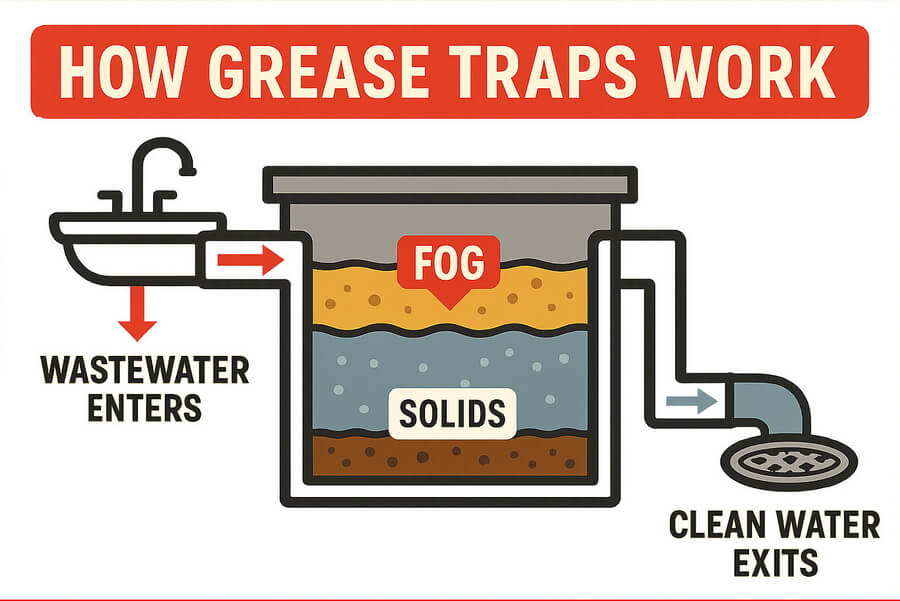
Grease trap compliance is unusual because doing the work isn't enough — you also have to prove you did it.
Every food-service kitchen sends fats, oils, and grease down the drain, and the local sewer authority requires that grease to be captured in a trap and pumped out on a set schedule, before it hardens into the blockages that cause sewer backups. But the thing an inspector actually asks for isn't a clean trap — it's the manifest: the signed proof from a licensed hauler that each pump-out happened, on time, and was disposed of properly. So compliance has two failure modes that feel very different. Skip a scheduled pump-out and you risk a grease blockage, a backup, and fines. Keep pumping faithfully but lose the manifests, and at inspection you can't prove any of it, which is treated as if it didn't happen. Add a wastewater discharge permit that renews, and a cadence the authority can tighten if it finds grease, and there's more to track than "get the trap cleaned." Here's how FOG compliance works, and how to stay both pumped and provable.
1. What is grease trap / FOG compliance?
FOG (fats, oils, and grease) compliance is the set of requirements that keep a food-service establishment from sending grease into the sewer system. It centers on a grease interceptor or trap that must be pumped and cleaned on a schedule set by the local authority, with a manifest from a licensed hauler documenting each service, and usually a wastewater discharge permit. Remindax helps you track the pump-out cadence, permit renewal, and manifest retention per location and reminds you; it doesn't pump traps, haul grease, or file with the authority.
The reason this obligation behaves differently from most of the dated requirements a restaurant carries is that there is nothing to look at. A license hangs on a wall with a date on it. A certificate has an expiry printed across the front. This is a steel or concrete box in the floor, in the yard, or under the parking lot, and it looks exactly the same the day after a service as it does eleven weeks later. Whether you are compliant is a question about paperwork, not about plumbing — which is precisely why it slips.
1.1 The parts to keep current
- →Pump-out / cleaning — on a cadence set by the local authority, which commonly varies with the size of the trap and the volume of grease the kitchen produces.
- →The manifest — proof of each pump-out by a licensed hauler, retained on site and produced when an inspector asks for it.
- →Discharge / wastewater permit — where one is required for the premises, running on its own renewal cycle.
- →Cadence review — the authority can tighten the schedule if grease is found where it shouldn't be, so today's interval is not permanent.
Exactly what applies — how often the trap must be pumped, how long manifests must be retained, whether a discharge permit is required at all, and who counts as a licensed hauler — is set by the local sewer or wastewater authority, and it genuinely differs from one municipality to the next. Confirm the specifics for each of your premises rather than assuming a single rule. What holds everywhere is the structure: a service that recurs, a document that proves it, and a permit underneath.
Most compliance evidence in a commercial building is attached to the thing it describes. A serviced extinguisher carries a tag, and the whole system of fire safety inspection tracking works because you can walk up to a device and read where it stands. An elevator certificate is framed inside the car for every passenger to see. A scale that has passed weights and measures certification wears a physical seal applied by the official who tested it. In each case the asset announces its own status.
A grease trap announces nothing. No tag is fixed to it, no certificate is issued for it, no seal is applied, and in most places the authority holds no independent record of your last service either. The only artifact that exists anywhere is a sheet of paper a driver handed to whoever was in the kitchen at the time. That is the whole reason the manifest carries so much weight here: it isn't supporting evidence for a status you could verify some other way — it is the only evidence there is.
| Serviced equipment | Grease trap | |
|---|---|---|
| Where the status shows | On the asset — a tag, a seal, a posted certificate | Nowhere on the asset at all |
| Who issues the proof | An inspector or a certifying service provider | The licensed hauler you hired, at the truck |
| If the paperwork is lost | The tag or seal still shows the date | Nothing shows anything |
| What an inspection tests | Whether the equipment is current | Whether you can produce the record |
The permit sitting underneath is a smaller part of the picture than people expect, and it behaves like any other authorization: it has a term, and it renews. That side of the obligation has more in common with an air, water, or waste permit at a fixed facility than with anything described above, and if your premises carries several such authorizations they're best held together in one register. What makes FOG distinct isn't the permit — it's everything the permit obliges you to do between renewals, and the paper trail that has to show you did it.
2. How often does a grease trap need pumping?
Set by the authority according to trap size and grease volume — commonly somewhere between monthly and quarterly.
Signed proof of each pump-out by a licensed hauler, retained and produced on request.
A wastewater or discharge permit for the premises, where required, renewing on its own cycle.
The service happened and you can prove it. Either half missing is a failure.
The manifest is the distinctive part — a clean trap doesn't satisfy an inspector without the paperwork, so tracking proof-of-service matters as much as the service itself.
It's worth being precise about what sets the number, because "how often" is the question every operator asks and the answer isn't a rule you can look up once. Some authorities work from a formula involving the trap's capacity and the kitchen's output. Some apply a blanket interval to every food-service premises in the jurisdiction. Many use a practical test instead: the trap must be serviced before the grease and solids reach a stated proportion of its depth, which converts a fixed-sounding requirement into one that moves with how you actually cook. A pizzeria and a coffee shop with identical traps can easily land on different schedules, and the same kitchen can shift onto a shorter cycle after adding a fryer.
Almost every recurring compliance interval a business carries is fixed by rule and identical for everyone it applies to. An annual test is annual for every operator in the state. A monthly record is monthly whether you are careful or careless. The interval is a fact about the requirement, not a fact about you, and nothing you do changes it.
A pump-out cadence is not like that. It is assigned to your premises, and the authority can revise it — so if grease turns up in a line, or an inspection finds the trap fuller than it should be, the answer may be that you are now on a shorter cycle than you were last year. The schedule is a judgment about your kitchen, and a poor result makes the following year more demanding rather than less. That has a practical consequence worth planning around: the interval in your reminders is not a permanent setting. It is the current one, and it can be changed by someone outside your business, without your agreement, on the strength of a single visit.
3. Why tracking grease trap dates matters
Four things make this harder to carry than a single recurring service call, and each one hides the others:
A missed pump-out risks a backup
Skip the scheduled cleaning and grease can harden into blockages — sewer backups, fines, and surcharges follow.
No manifest means no proof
Even faithful pumping fails inspection if the manifests aren't retained; unprovable compliance is treated as non-compliance.
The cadence can change
Authorities can tighten the pump-out schedule if grease is found, so the interval isn't fixed forever.
Chains multiply the locations
A restaurant group has a trap, a cadence, a permit, and a manifest trail at every site — a lot to keep together.
Underneath all four sits a staffing problem the rules never account for. In most kitchens the person who meets the hauler at six in the morning is whoever happens to be on shift, and the manifest is handed to them in a doorway while a delivery is being unloaded. It is not filed by a compliance officer; it is put down somewhere by a line cook. Hospitality also turns its people over faster than almost any other industry, so the institutional memory of when the trap is due, who services it, and where the last year of paperwork went can leave with a single resignation. Nothing about that is visible until an inspector asks — which is why the gap is usually a year deep by the time anyone discovers it.
4. Who needs to track grease trap compliance
Five groups carry these dates most often, and the problem looks different depending on how many kitchens you're responsible for:

Restaurants & food service
The pump-out schedule and manifests per kitchen — usually held by whoever also holds the licenses, the certificates, and everything else with a date on it.
Learn More
Restaurant & franchise groups
FOG compliance across every location — where each site may sit under a different authority, on a different cadence, with a different hauler.
Learn More
Cafeterias & institutions
Schools, hospitals, and corporate dining — high-volume kitchens where the obligation belongs to facilities rather than to anyone in a chef's jacket.

Food processors
Larger interceptors and discharge permits, where the volumes involved put the site under closer attention than a single restaurant would attract.

Facilities managers
Grease compliance sitting among every other building obligation — one more recurring service on a list already full of them, and the one with no tag to check.
Learn MoreFor all five, this date lives next to the rest of the paperwork a food premises has to keep current — the operating authorizations held in permit tracking software, the business license for each site, the food handler cards the crew works under, and the food-safety plan behind the menu. What sets the trap apart from all of them is the direction the failure travels. Everything else on that list protects the premises, the customers, or the staff. This one protects a public sewer that runs underneath the street, which is why the authority polices it with surcharges and why the cost of getting it wrong can land somewhere other than your own building.
5. What happens when grease trap compliance slips
FOG compliance fails in two directions, and both are costly. Miss a scheduled pump-out and the trap keeps filling; grease that isn't removed hardens in the lines and can cause a sewer backup — a health hazard, a shut-down kitchen, an emergency call-out, and often fines and sewer surcharges from an authority that takes grease blockages seriously. The other failure is quieter and catches conscientious operators off guard: the pumping happened, but the manifests weren't kept, so when an inspector asks for proof of the last several services, there's nothing to show — and unprovable compliance is treated as non-compliance, with the same penalties.
There's also a moving target. If the authority finds grease where it shouldn't be, it can tighten your pump-out cadence, so last year's schedule may no longer be enough. Across a group of locations, each with its own trap size, cadence, permit, and manifest trail, the lapse is usually one site's pump-out or paperwork slipping unnoticed. Tracking the schedule, the permit, and the manifests per location is what keeps a kitchen both compliant and able to prove it.
It helps to be clear about where the danger sits, because the two halves recover very differently. An overdue pump-out is a booking problem, and booking problems can be solved: you call the hauler, the truck comes, the trap is emptied, and what remains is a gap in the schedule rather than a permanent hole. Unpleasant, potentially expensive if a line has already blocked, but fixable in a phone call. That is not the case for every recurring record — a regulated tank's monthly leak-detection record describes a month that has passed, so a missed one stays missed no matter what you do afterwards.
The manifest sits between those two cases, and knowing which side it falls on is worth something on the day you need it. Because the record is generated by a third party rather than by you, the service you paid for did leave a trace somewhere — a hauler's own records, an invoice, a disposal receipt at the treatment facility. A manifest that was mislaid is usually recoverable from the company that issued it, if you know which company that was and when. What isn't recoverable is a pump-out that never happened, and what makes the recovery hard in practice is the same thing that made the loss possible: nobody wrote down which hauler came, or when. Retaining the manifest as it arrives is cheap. Reconstructing a year of them from memory, under an inspector's deadline, is not.
One more consequence is worth naming because it arrives long after the fact and lands on someone else's desk entirely. Grease blockages don't stay on your property — they travel, and authorities investigating a backup in a shared line will work back along it to the establishments that discharge into it. If your service history is complete, that inquiry ends quickly. If it isn't, the absence of records is not read as an administrative slip; it is read as the most likely explanation for what happened. The paperwork stops being a compliance formality at that point and starts being the only account you have of what your kitchen did and didn't send down the drain.
6. How Remindax keeps every kitchen compliant and provable
Remindax is built for exactly this shape of obligation — a recurring service, a document that has to survive after it, and a permit underneath — held per location and repeated across sites. It sits inside the wider register of dated requirements a business carries in compliance tracking software, alongside the licenses and certificates each premises already holds. Four pieces work together:
Every location's FOG obligations in one dashboard
Pump-out cadence, discharge permit, and manifest retention per site — with status at a glance. Pairs with the Locations asset profiles.
Pump-out & permit reminders
Recurring alerts before each scheduled cleaning and before the permit renews, by Email, SMS, and WhatsApp — to the site, not just to head office.
Manifest retention
Keep each pump-out's manifest organized per location, so the proof is where you can find it on the morning an inspector asks.
Audit-ready records
Export a site's pump-out and permit history for an inspector or head office, with a record of when each service was due.
Remindax tracks the dates and cadences you set and reminds you — it doesn't pump traps, haul grease, dispose of waste, or file anything with the authority. Pumping and disposal are done by your licensed hauler; the manifest is issued by them; the permit is yours to apply for and renew. It also isn't a grease-hauling service, a waste-management platform, or a municipal FOG-program system, and it doesn't assess whether your trap is due. Remindax makes sure the date to call the hauler never passes unnoticed, and that the paperwork they hand over is somewhere you can find it.
7. Why spreadsheets fail for grease trap tracking
FOG compliance is a recurring service, a document trail, and a renewable permit across every kitchen — and a spreadsheet keeps none of them reliably. It won't remind anyone that a location's pump-out is due before the trap overflows into the lines, won't flag the missing manifest until an inspector asks for it, and won't roll a chain's traps into one view. Because the failure is either a backup or an unprovable record, both expensive, the missed date bites hard. An automated system holds each location's pump-out cadence, permit renewal, and manifest trail and reminds the right people before each — so every kitchen stays pumped, permitted, and able to prove it.
There's a second reason a file struggles here, and it's about the gap between the two halves of the obligation. A tracker can record that a pump-out was scheduled. What it can't do is notice that the service happened and the paperwork didn't arrive — that a row was ticked in March and no document was ever attached to it. That is the exact failure this obligation produces most often, and it is invisible in a spreadsheet by design, because a completed row looks identical whether the manifest is in the folder or in a bin behind the kitchen. Holding the reminder and the document in the same place is what turns "we think it was done" into something you can put in front of an inspector.
- ✗No prompt before a pump-out falls due, so it depends on someone remembering
- ✗A ticked row looks the same whether or not the manifest was ever kept
- ✗Nothing carries a tightened cadence through to next year's schedule
- ✗A group's sites sit in separate files nobody compares
- ✗The gap is discovered by an inspector, or by a blocked line
- ✓Recurring alerts hold each location's pump-out cadence
- ✓The manifest is attached to the service it proves, per site
- ✓Change the interval once and every future reminder follows it
- ✓Permit renewals tracked beside the services they authorize
- ✓Reminders by Email, SMS, and WhatsApp — to the people in the kitchen
8. Key takeaways
- ✓FOG compliance requires capturing grease in a trap and having it pumped on a cadence set by the local authority.
- ✓Compliance is two-part: the pump-out must happen on schedule and the manifest must prove it.
- ✓Missing a pump-out risks blockages, backups, fines, and surcharges; missing manifests means unprovable compliance.
- ✓The authority can tighten the pump-out cadence if grease is found, so the schedule isn't fixed.
- ✓Tracking the pump-out cadence, discharge permit, and manifests per location keeps a kitchen compliant and provable.
Never be caught unpumped — or unable to prove it
Track every pump-out, permit, and manifest — automatically. Whether it's one kitchen or fifty, Remindax holds each location's cadence on its own schedule and reminds the people who actually meet the truck.
GDPR-ready · AWS secure cloud · Encrypted storage · Setup in under 5 minutes
9. Frequently Asked Questions
On a cadence set by the local authority based on trap size and grease volume - often monthly to quarterly - and it can be tightened if grease is found. Confirm the interval that applies to your own premises.
The signed proof from a licensed hauler that a pump-out was performed and the waste disposed of properly. It generally must be retained on site and produced when an inspector asks for it.
No - you also have to be able to prove it. Nothing on the trap itself records its status, so without the manifests compliance is unprovable at inspection and treated as non-compliance.
Grease can harden and cause sewer backups, along with fines and surcharges, since authorities treat grease blockages seriously.
Often yes, because the record was created by a third party - the hauler that performed the service usually holds its own copy, and an invoice or disposal receipt may support it. That is what separates a mislaid manifest from a recurring record you generate yourself, such as a tank's monthly leak-detection log, which cannot be produced after the month has passed. What you cannot recover either way is a pump-out that never happened.
Yes - if the authority finds grease where it should not be, it can require a more frequent pump-out cadence. The interval is assigned to your premises rather than fixed by rule, so it can be revised without your agreement.
No - Remindax tracks the pump-out cadence, permit, and manifest dates and reminds you. Pumping and disposal are done by your licensed hauler.
Yes - each site's pump-out cadence, discharge permit, and manifests in one place, each with its own reminders.
Yes - a forever-free plan, no credit card required.